In slurry pump selection, rubber lining and ceramics are the two most frequently compared non-metallic wear-resistant materials. Both offer advantages that metal pumps struggle to match in terms of abrasion resistance or corrosion resistance, but their failure mechanisms are fundamentally different. Choose correctly, and a rubber pump can deliver satisfactory service life at a relatively low cost. Choose incorrectly, and a ceramic pump may suffer catastrophic cracking within weeks.
This article starts from the particle characteristics of the slurry and outlines the applicable boundaries of rubber and ceramics, helping you make an informed decision in real-world operating conditions.
The Core Difference: Elastic Absorption vs. Hardness Resistance
Understanding the essential difference between the two materials is the prerequisite for correct selection.
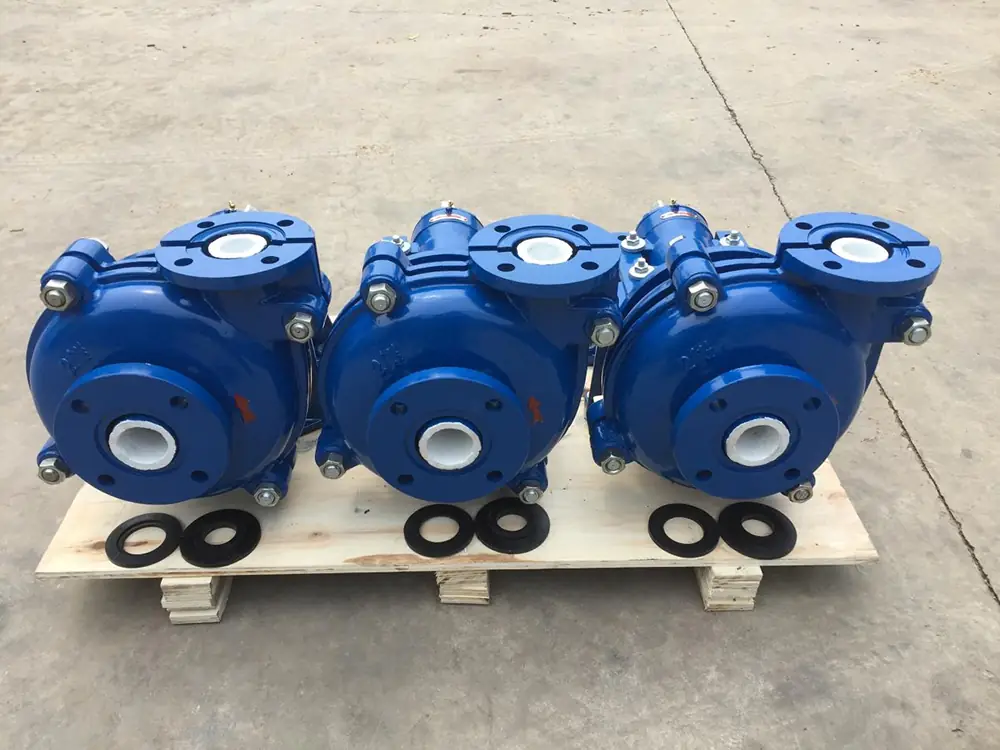
Rubber lining relies on an elastic deformation mechanism. When particles in the slurry impact the rubber surface, the rubber deforms locally, absorbing the kinetic energy of the particle, then rebounds to “bounce” the particle away without the material itself being cut away. This mechanism is extremely efficient when particles are fine and rounded—rubber wear can be almost negligible. However, if the particles have sharp angular edges or if the particle size is too large, the energy carried by a single particle exceeds the elastic recovery capacity of the rubber, and the rubber will be “cut” or “torn.”
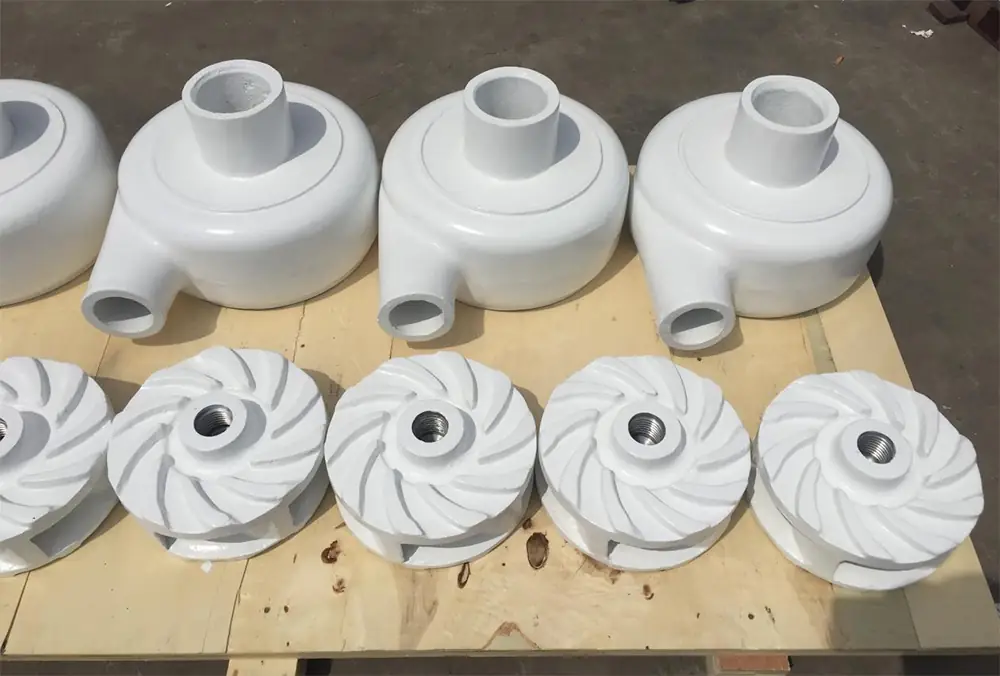
Ceramics (primarily silicon carbide or alumina) rely on a hardness resistance mechanism. Silicon carbide has a Mohs hardness of 9–9.5, second only to diamond. When sharp, hard particles impact the ceramic surface, the ceramic does not “yield” like rubber but instead “holds firm” with its hardness, preventing particles from effectively cutting the surface. However, the fatal weakness of ceramics is brittleness—it cannot absorb impact energy through plastic deformation. When large particles or foreign objects strike the ceramic with sufficient energy, the material will chip or even fracture completely.
In short: rubber “overcomes hardness with softness,” while ceramics “meet hardness with hardness.” The applicable range of each depends on how “hard,” how “sharp,” and how “large” the particles in your slurry are.
Applicable Boundaries of Rubber-Lined Pumps
Rubber-lined pumps have a long application history in slurry transport, and their optimal operating conditions are clearly defined.
Most suitable slurry types: Fine-particle, rounded-shape slurries are rubber’s “comfort zone.” Typical applications include tailings transport, coal slurry, fine mineral slurry, and water treatment sludge. In these conditions, particle size is typically less than 6.5mm, and particle shapes are mostly round or semi-round. Experimental data shows that natural rubber lining can still exhibit excellent erosion resistance for solid particles up to 12mm, but in impeller applications, resistance to particles exceeding 6mm drops significantly.
Key particle size and shape thresholds: The industry-recognized upper limit for rubber application is particle hardness not exceeding Mohs 6.5, and particles must not have sharp angular edges. If the slurry contains sharp particles like anthracite, the rubber will be rapidly cut. Additionally, particles exceeding approximately 6–8mm will cause excessive impact on the rubber, because the energy carried by a single particle exceeds the elastic recovery capacity of the rubber.
Other limitations of rubber: Natural rubber has poor resistance to oils, solvents, and strong oxidizers, and will swell and degrade upon contact. In terms of temperature, natural rubber is typically limited to below 75–80°C; exceeding this causes thermal aging. Synthetic rubbers such as EPDM can raise the temperature limit to 120°C, but abrasion resistance is usually lower than optimally formulated natural rubber.
An easily overlooked detail: Modern rubber pump lining designs are not “one rubber fits all.” Different locations in the pump chamber have different wear mechanisms—near the impeller cutwater, particles impact at high angles, and softer, more elastic rubber is actually more wear-resistant; in other areas dominated by sliding wear, harder rubber performs better. This means that high-quality rubber pumps use different rubber hardness formulations in different areas of the same pump.
Applicable Boundaries of Ceramic Slurry Pumps
Ceramic pumps have become a technological hotspot in recent years, but their “advantages” are conditional.
Ceramics’ “home turf”: The scenario where ceramics are truly irreplaceable is combined severe corrosion + hard particles. For example, the chemical industry transporting phosphoric acid slurry or titanium dioxide metatitanic acid pulp, or the metallurgical industry handling tailings containing acidic media. Silicon carbide ceramics undergo virtually no chemical corrosion in the vast majority of acid-base media except hydrofluoric acid and high-temperature concentrated alkali, while their hardness is sufficient to resist the cutting action of hard particles such as quartz sand and slag.
Particle size and impact limitations: The greatest risk to be vigilant about in ceramic slurry pump selection is large particles and foreign objects. The fracture toughness of silicon carbide ceramics is far lower than that of metal, and its ability to resist impact loads is weak. When the slurry contains large particles exceeding the specified size, or occasionally mixed-in metal foreign objects (such as bolts or anchor heads), there is a risk of cracking in the ceramic lining. Therefore, operating conditions using ceramic pumps typically require effective inlet grates or iron removal devices to minimize the risk of accidental impact.
Broad temperature and chemical adaptability: Ceramics have far greater temperature resistance than rubber. Silicon carbide can work long-term at above 120°C, and alumina ceramics can withstand even higher temperatures. In terms of chemical compatibility, ceramics cover a wide pH range from strong acids to strong bases, an advantage that rubber pumps cannot match.
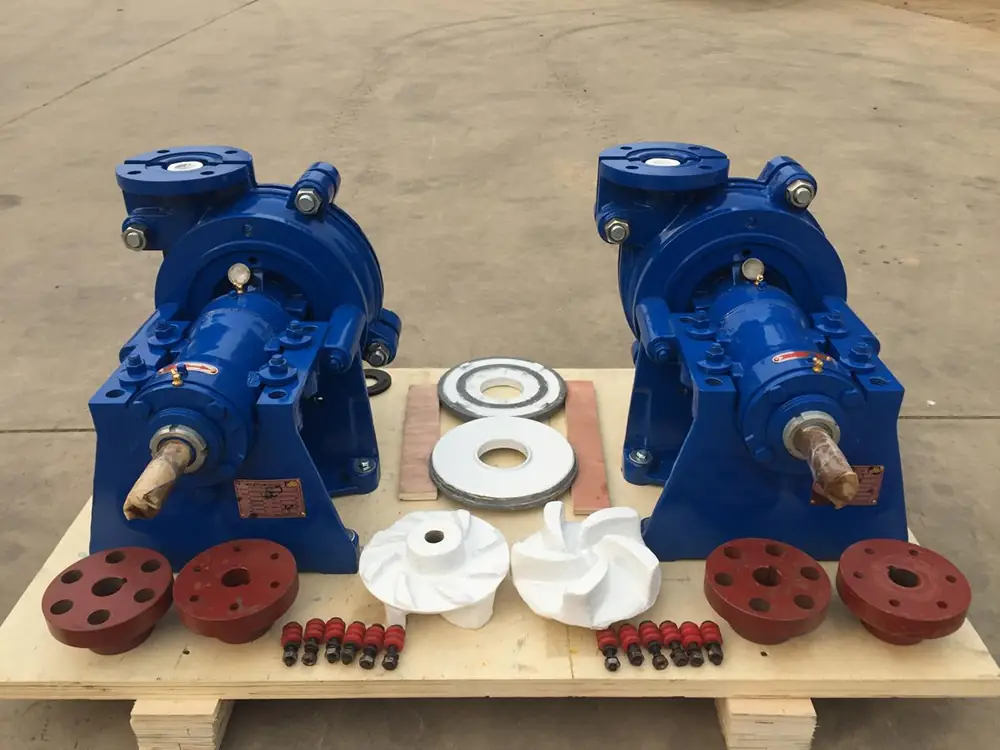
A noteworthy technological advancement: The “brittleness” of traditional ceramics is not irremediable. Through structural design and process optimization, the impact resistance of modern ceramic pumps has been significantly improved. For example, internal-external pressure self-balancing sheath structures and composite designs of metal skeleton with ceramic lining have compensated to some extent for the toughness shortcomings of ceramics. Some manufacturers claim that through special treatment processes, the impact strength of silicon carbide ceramics can reach 80 times that of ordinary ceramics, enabling application in slurry conditions with solid particle impact. However, even so, ceramic pumps are still not suitable as a “universal solution,” and the risk of large-particle impact always requires careful evaluation.
Selection Decision Framework: From Slurry Parameters to Material Lock-In
Based on the above analysis, a concise decision logic can be established.
Step 1: Determine whether particles are “sharp”
This is the most critical screening criterion. If the particles in the slurry are predominantly sharp-angled (e.g., crushed ore, anthracite), rubber will be rapidly cut, and the rubber option should be directly eliminated. If the particles are predominantly rounded (e.g., fine tailings after mill grinding), rubber is the preferred direction.
Step 2: Determine whether particles are “hard”
Use Mohs hardness as a quantitative indicator. For particles with hardness below 6.5, rubber’s elastic mechanism can effectively cope. For particles with hardness above 6.5 (such as quartz, garnet, slag), the wear rate of rubber rises sharply, and ceramics or other hard materials should be considered.
Step 3: Determine whether particle size is “large”
The upper particle size limit for rubber is approximately **6–8mm** (depending on specific operating conditions and rubber formulation). Particles exceeding this size carry too much impact energy; rubber may tear, and ceramics may chip. In such cases, high-chrome alloy or other metallic materials are often the more reliable choice. Although ceramics are wear-resistant, **particles exceeding the ceramic design limit also pose a cracking risk**, and the impact problem cannot simply be overridden by “ceramics are wear-resistant.”
Step 4: Overlay corrosion and temperature conditions
If the slurry simultaneously has strong corrosiveness (low pH or high chloride ions) and contains high-hardness particles, the service life of the rubber option will be greatly shortened under the dual attack of corrosion and abrasion. Only then does the “wear-resistant + corrosion-resistant” combination advantage of ceramics truly manifest. In terms of temperature, rubber is essentially out of the picture above 80°C, making ceramics or metal the inevitable choice.
Common Misjudgments and Recommendations
In practice, misjudgments occur frequently in both directions.
One misjudgment is the “ceramics are universal” fallacy. Seeing that ceramics have high hardness and long life, one assumes that ceramic pumps should be used in all operating conditions. However, the initial purchase cost of ceramic pumps is significantly higher than rubber pumps. If the operating conditions do not involve strong corrosion or extremely hard particles, choosing ceramics will not bring equivalent total cost of ownership benefits. More importantly, in conditions containing large particles, the cracking risk of ceramics may turn “long life” into “short life.”
The other misjudgment is “rubber is cheap and good enough.” Forcing rubber pumps in conditions with sharp or high-hardness particles may result in frequent lining replacement, with downtime losses far exceeding the price difference of the equipment itself.
Practical recommendation: Before selection, be sure to provide the ceramic slurry pump Supplier with as complete slurry parameters as possible—particle size distribution (D50/D85), particle shape description, Mohs hardness, solid concentration, pH value, and temperature. For uncertain operating conditions, a hybrid configuration can be considered: for example, a metal impeller combined with rubber lining (MR type), which takes advantage of rubber’s abrasion resistance while accommodating impact resistance. This “compromise” strategy is often more prudent than forcing a choice of one extreme material when slurry characteristics are complex and a single material cannot fully adapt. When evaluating a ceramic slurry pump Supplier, it is also advisable to request reference cases from the same industry to verify whether the material selection logic aligns with your actual operating conditions. A qualified ceramic slurry pump Supplier should be able to provide not only product specifications but also material selection recommendations based on your specific slurry parameters.