Key Takeaways
- A horizontal slurry pump is designed to handle slurry containing solid particles and abrasive materials. A standard horizontal centrifugal pump is generally better suited to relatively clean liquids.
- The main difference goes beyond mounting direction. The two pump types also differ in flow passage design, wetted materials, wear resistance, shaft sealing, bearing configuration, and solids-handling capacity.
- Pump selection should consider more than flow rate and head. Solids concentration, particle size, slurry temperature, abrasiveness, corrosiveness, and expected operating time also matter.
- For mining, mineral processing, tailings, dredging, and other high-solids applications, buyers should select the pump based on actual slurry conditions. A complete technical data sheet is more useful than comparing standard pump performance or price alone.
How Do Solid Particles Affect Pump Wear?
When slurry enters a pump, solid particles move through the impeller and casing with the liquid. They repeatedly strike and rub against the wetted parts. This is one of the main causes of wear in slurry handling.
For example, hard mineral particles can strike the impeller blades as they pass through the pump. Once they enter the casing, they may continue moving at high speed along the flow path. Over time, this can wear down the casing surface.
As operation continues, the impeller and casing may become thinner. Severe wear can create grooves or even holes. Pump performance may then decline, which can lead to maintenance and downtime.
Wear levels vary with the slurry and operating conditions. Harder or larger particles usually cause greater impact. Higher solids concentrations and faster flow rates can also increase wear.
Particle shape matters as well. Sharp, hard particles are more likely to cause cutting and abrasive wear. Therefore, the same pump may have a very different service life when handling clean water versus high-concentration mineral slurry.
How Do Horizontal Slurry Pumps and Standard Centrifugal Pumps Differ in Design?
One of the most important differences is how the flow passages handle solid particles.
Standard centrifugal pumps often use closed impellers with relatively narrow passages to achieve good hydraulic efficiency. This works well with clean water or liquids containing few solids. However, larger or harder particles can increase the risk of blockage, erosion, and performance loss.
Slurry pumps usually use open or semi-open impellers with wider flow passages. With more space for solids to pass through, the risk of particle buildup and blockage inside the impeller or casing is reduced.
| Parameter | Horizontal Slurry Pump | Standard Horizontal Centrifugal Pump |
| Main application | High-solids, abrasive slurry | Clean or relatively clean liquids |
| Impeller type | Open or semi-open, wide flow passages | Usually closed, narrower passages |
| Typical slurry pump flow rate | Approx. 10–2,000 m³/h | Depends on the application |
| Typical slurry pump head | Approx. 10–100 m | Depends on the application |
| Maximum particle size | Up to approx. 90 mm, depending on the pump model | Usually suitable for smaller particles |
| Maximum solids concentration | Up to approx. 60%, depending on the design | Generally not suitable for high-solids slurry |
| Wetted materials | High-chrome alloy, rubber lining, 2205/2507 duplex stainless steel, etc. | Standard metals or corrosion-resistant materials |
| Wear protection | Heavy-duty wear-resistant wetted parts | Standard hydraulic components |
| Shaft seal | Heavy-duty mechanical seal with flush water or packing seal | Standard mechanical seal or packing seal |
| Bearing arrangement | Heavy-duty bearings with oil lubrication | Standard bearing configuration |
| Typical efficiency | Approx. 60%–70% | Approx. 75%–85% for clean liquids |
How Do You Choose a Horizontal Slurry Pump for Long-Term Operation?
The right horizontal slurry pump should match the actual slurry conditions rather than just the required flow rate and head.
Solids concentration, particle size, abrasiveness, and corrosiveness all affect the choice of impeller, casing, and sealing arrangement. When the pump structure and materials match the medium, wear can be reduced and service life can be improved.
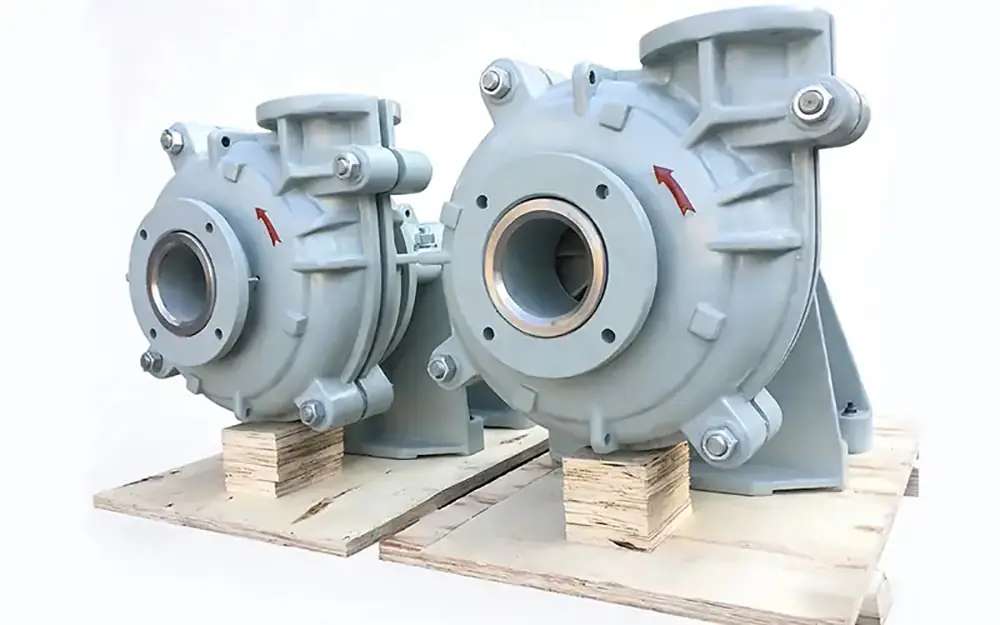
Following this approach, Kairun horizontal slurry pumps are available with high-chrome alloy, rubber-lined, and 2205/2507 duplex stainless steel wetted parts. Wide-passage impellers and heavy-duty construction are also available for high-solids and highly abrasive slurry applications.
1. How Does Kairun Extend the Service Life of Key Wetted Parts in Abrasive Applications?
In applications such as mineral slurry and tailings transport, the impeller and casing are among the parts most exposed to wear. Solid particles repeatedly strike and rub against these surfaces as the slurry moves through the pump.
If conventional materials such as cast iron or carbon steel are used in highly abrasive conditions, the impeller may become thinner over time. Localized casing wear or even holes can also develop.
For mining and mineral processing operations, such damage can mean more than replacing a single part. It may also cause downtime across the slurry transport process.
Kairun offers high-chrome alloy wetted parts for highly abrasive slurry. Depending on the operating conditions, rubber lining or 2205/2507 duplex stainless steel can also be selected.
High-chrome alloy is mainly intended for strongly abrasive slurry. Rubber lining can suit certain particle and temperature conditions. Duplex stainless steel is useful when both corrosion resistance and mechanical strength are required.
Under similar operating conditions, high-chrome alloy wetted parts can provide a wear life approximately 5–10 times longer than standard cast iron or carbon steel.
2. Why Does Kairun Use Wide-Passage Impellers for High-Solids Slurry?
Material wear is only part of the challenge. The ability to pass solid particles also affects reliable slurry transport.
Standard centrifugal pumps often use closed impellers with relatively narrow passages. Such impellers can provide high hydraulic efficiency when handling clean liquids. However, larger particles or high solids content can restrict their movement. The risk of blockage and localized wear may also increase.
Kairun horizontal slurry pumps use open or semi-open impellers with wide flow passages. The wider passages give solid particles more room to pass through. The design therefore focuses on reliable solids handling rather than maximum efficiency with clean liquids.
Depending on the pump model, the maximum particle size can reach approximately 90 mm. The maximum solids concentration can reach approximately 60% by weight. Typical slurry pump flow rates range from about 10 to 2,000 m³/h, while typical heads range from about 10 to 100 m.
A narrow impeller passage can lead to frequent blockage, wear, or downtime. In such cases, a higher rated efficiency alone does not guarantee reliable operation. Kairun therefore focuses on stable solids handling, wear reduction, and fewer unplanned shutdowns.
3. How Does Kairun Handle Different Slurry Conditions with Different Materials?
Slurry properties can vary greatly between applications. Some slurries contain large amounts of hard mineral particles, making abrasive wear the main concern. Others contain both solid particles and corrosive chemicals.
These conditions place different demands on pump materials. Using the same material for every application may result in excessive wear or inadequate corrosion resistance.
horizontal centrifugal pump Supplier can be configured with wetted materials based on the actual slurry conditions.
For high-solids, highly abrasive slurry, high-chrome alloy can be paired with a wide-passage impeller to improve wear resistance. For corrosive slurry, 2205/2507 duplex stainless steel can be selected according to the medium. For high-temperature slurry, the material should be selected based on the actual temperature and slurry properties.
Matching the material to the slurry helps prevent premature damage to key components. It can also extend operating intervals and support more reliable long-term slurry transport.
FAQ: Common Questions About Horizontal Slurry Pump Selection
Q1: Why Does a Standard Centrifugal Pump Wear Out Quickly When Handling Solids?
A: A standard centrifugal pump may use a closed, narrow-passage impeller with conventional cast iron materials. Hard solid particles can cause rapid wear or blockage as they pass through the pump. This may lead to frequent replacement of wear parts.
Q2: Can a Slurry Pump and a Standard Centrifugal Pump Be Used Interchangeably?
A: In some applications, they may be interchangeable for clean water or low-wear liquids. However, high-solids or abrasive slurry requires a pump designed for those conditions. Using a standard centrifugal pump in such service can result in a much shorter service life.
Q3: Why Do Slurry Pumps Use Open Impellers?
A: Open or semi-open impellers provide wider flow passages. Solid particles therefore have more room to pass through. This can reduce blockage and wear during slurry handling.
Q4: How Should I Choose the Right Wear-Resistant Material?
A: For highly abrasive slurry, a high-chrome alloy such as Cr27 is a common choice. For combined corrosion and abrasion, 2205 or 2507 duplex stainless steel may be suitable. Rubber lining can be considered for applications with moderate wear and compatible temperatures.
Q5: Does a Slurry Pump Require Special Maintenance?
A: Yes. Operators should regularly check impeller and liner wear, mechanical seal flush water, and bearing lubrication. Wear parts should be replaced when they reach the manufacturer’s specified limit.
Conclusion
The choice between a horizontal slurry pump and a standard centrifugal pump depends mainly on the pumped medium and the pump design. When slurry contains a high concentration of solid particles, continuous impact and abrasion can quickly wear the impeller, casing, and other wetted parts.
A horizontal slurry pump is better suited to these conditions because it can combine wide-passage impellers, wear-resistant materials, heavy-duty bearings, and reinforced sealing arrangements. These features help it handle high-solids and highly abrasive slurry more reliably.
If you are comparing options from a horizontal centrifugal pump Supplier, look beyond flow rate and head. Check the solids concentration, particle size, wetted materials, impeller design, and sealing arrangement as well.
If you are sourcing directly from a horizontal centrifugal pump Factory, ask for a complete technical data sheet before making a decision. You can also request a horizontal centrifugal pump Pricelist to compare configurations and confirm which option best suits your application.