Overview
The horizontal self-priming sewage pump is a special type of horizontal centrifugal pump, commonly known in the industry as a sewage pump. It integrates two core performance characteristics: self-priming sewage discharge and high-suction conveying, making it the mainstream ground-based conveying equipment for sewage pumping stations and river water pumping stations. Unlike ordinary submersible sewage pumps, the entire unit is horizontally dry and floor-mounted, requiring no immersion in the liquid surface. With its high-suction structure, it can automatically pump sewage containing fibers, silt, and particles from low-level collection wells, rivers, and underground sewage tanks. It eliminates the need for a foot valve in the pipeline and requires no priming after a single filling, perfectly solving industry pain points such as large liquid level fluctuations, limited maintenance space, and difficulties in maintaining underwater equipment.
Core Working Principle and High-Suction Structure Design
This pump adopts an axial back flow external mixing self-priming structure, with its own liquid storage chamber and gas-liquid separation chamber, forming a complete high suction pump system. During initial operation, the pump chamber is filled with medium. After startup, the impeller rotates at high speed, thoroughly mixing the liquid stored inside the pump with the air in the suction pipe. The gas-liquid mixture enters the separation chamber, the air is discharged from the outlet, and the liquid flows back to the pump body, continuously creating a vacuum. This rapidly lifts sewage from lower elevations into the pump for continuous transport. After shutdown, the one-way sealing structure locks in the water in the pump chamber, eliminating the need for repeated priming during subsequent start-ups and shutdowns. The standard self-priming height for conventional models is 5-6 meters, suitable for complex conditions such as river water level differences and low-level water intake from underground sewage tanks.
The components feature a specially optimized anti-clogging structure: a wide-channel open/dual-channel impeller allows for smooth passage of plastic bags, cloth strips, silt, and small solid particles, eliminating the entanglement and clogging problems common in ordinary centrifugal pumps. The shaft seal uses a silicon carbide mechanical seal, resistant to wear from sewage impurities and providing short-term dry-run protection, significantly extending the overall service life of the machine.
Core Product Advantages
High Suction Lift Adapts to Complex Water Intake Conditions
As a standard high-suction pump, it can handle water intake from rivers and underground sewage tanks with large drops in elevation. It can automatically re-suction even when water levels fluctuate or air enters the pipeline, eliminating the need for a vacuum priming unit and significantly reducing investment in pump station civil engineering and supporting equipment.
Dry Horizontal Installation, Safe and Convenient Operation and Maintenance
With the entire unit installed on the ground, the motor is completely isolated from the sewage medium, eliminating the risks of submersible pump immersion leakage and motor burnout. Maintenance requires no emptying of the water tank or lifting of equipment; simply open the cover to clean the impeller. It is especially suitable for small and medium-sized sewage pump stations and temporary drainage points.
High Versatility, One Machine Adapts to Multiple Media
With cast iron and 304/316 stainless steel pump bodies available, it can transport municipal sewage, industrial wastewater, river water, livestock manure, and construction mud, meeting both sewage discharge and river water intake needs.
Simplified installation and reduced construction costs: No foot valve is needed for the inlet pipe, reducing pipe resistance and leakage risks, and shortening the pump station construction cycle; the integrated horizontal base structure allows for both fixed and mobile installation, enabling rapid deployment in emergency flood drainage scenarios.
Core Application Scenarios (Main Equipment for Sewage Pumping Stations and River Pumping Stations)
Municipal Sewage Pumping Station
Used for lifting the collection wells of small and medium-sized regional sewage pumping stations and factory sewage treatment plants, conveying domestic sewage containing fibers and silt after the screen. Compared to submersible sewage pumps, horizontal self-priming sewage pumps do not require the construction of deep wells, resulting in lower pump house construction costs. Routine inspections and seal replacements do not require shutdown and emptying, making them suitable for sites with intermittent sewage discharge and few maintenance personnel; often using a one-in-one-out configuration, coupled with an automatic start-stop control system, enabling unattended sewage discharge.
River Water Pumping Station
Dedicated equipment for urban greywater replenishment, farmland irrigation, and factory circulating water intake from rivers. River water levels fluctuate significantly with the flood and dry seasons. The high suction lift characteristic allows for low-water intake, and the wide-flow-channel impeller is resistant to leaves and gravel carried by river water. Horizontal ground installation away from the river surface avoids motor submersion during floods, making it the preferred centrifugal pump model for small and medium-sized river pumping stations.
Industrial and Emergency Sewage Discharge Scenarios
Wastewater transportation from pits in chemical, paper, and dyeing workshops; drainage from construction site foundation pits; emergency flood drainage during urban rainy seasons; and septic tank wastewater transfer. The mobile horizontal self-priming sewage pump can quickly reach waterlogged areas without complex pre-buried pipelines, and its high suction lift performance rapidly pumps out low-lying water.
Key Considerations for Centrifugal Pump Brand Selection
When purchasing horizontal self-priming sewage pumps, three key indicators should be considered:
- Self-priming performance: Verify the measured stable suction head. For high-drop rivers and deep wells, prioritize vacuum-assisted high-suction-head models.
- Flow clogging prevention: Consider impeller flow channel width and anti-winding structure. For sewage containing high fiber content, choose a dual-flow-channel impeller.
- Material and sealing configuration: Cast iron pump bodies are used for ordinary municipal sewage. Stainless steel flow components are used for chemical corrosive wastewater and river raw water. Mechanical seals should be equipped with wear-resistant and corrosion-resistant friction pairs.
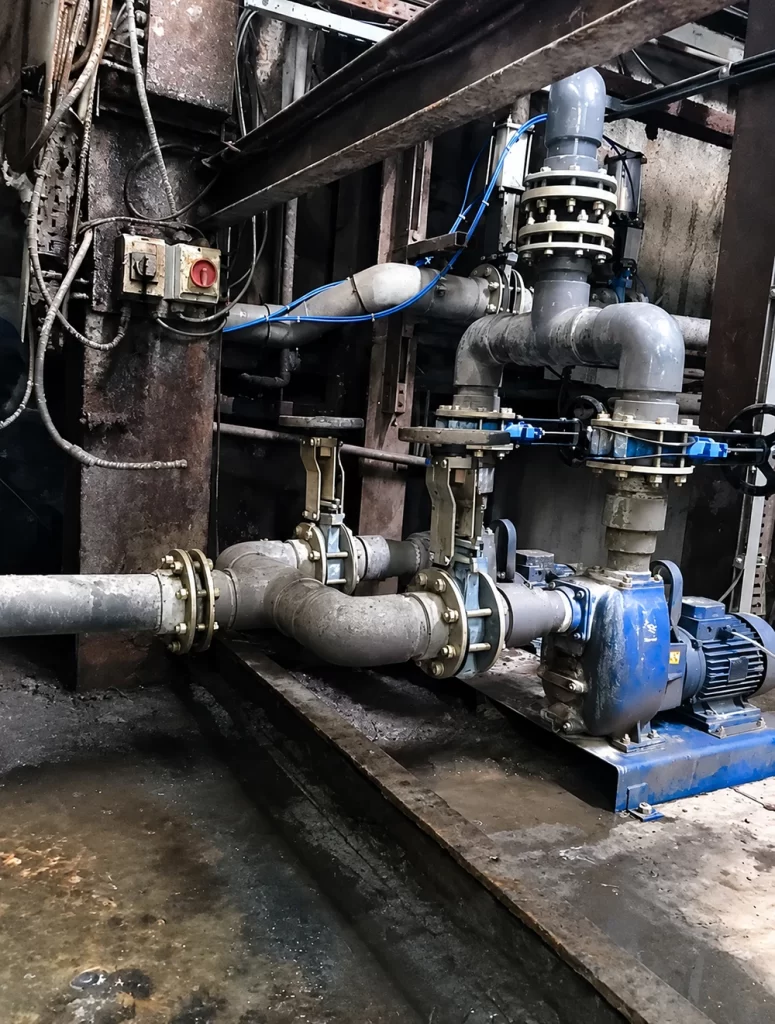
Leading professional centrifugal pump brands offer standardized ZW series horizontal self-priming sewage pumps with flow rates ranging from 5 to 800 m³/h, heads from 14 to 80 m, and power from 2.2 to 55 kW. These pumps can be matched with sewage pumping stations and river pumping stations of different sizes. They also support explosion-proof motors and remote control customization, making them suitable for chemical and outdoor explosion-proof environments.
Comparison of Horizontal Self-Priming Sewage Pumps and Submersible Sewage Pumps
Maintenance
Horizontal self-priming sewage pumps can be maintained on the ground, eliminating the need for pump hoisting or emptying the water tank; submersible sewage pumps require underwater hoisting, making maintenance procedures cumbersome.
Suction Lift
Horizontal self-priming sewage pumps are high-suction-lift pumps, capable of drawing water from low-lying areas over long distances; submersible sewage pumps lack self-priming capability and must be submerged in the liquid.
Land Use and Civil Engineering
Horizontal pump houses are simple to construct, requiring no deep sump digging; submersible sewage pumps require deep sump digging, resulting in higher civil engineering costs.
Disadvantages
For ultra-high flow rates and high-solids sludge transport, the performance is inferior to large submersible axial flow pumps, making them more suitable for small to medium flow sewage discharge and river water intake.
Conclusion
The horizontal self-priming sewage pump, as a specialized centrifugal pump combining high suction lift and self-priming sewage discharge capabilities, fills the gap of ordinary clean water pumps lacking sewage discharge capability and submersible sewage pumps lacking self-priming function. It is an indispensable fluid transport equipment for sewage lifting pump stations and river pump stations. In small and medium-sized municipal sewage, river water intake, and industrial emergency drainage projects, the centrifugal pump has become the main environmental water treatment pump promoted by major centrifugal pump brands due to its low operation and maintenance costs, flexible installation, and powerful high suction head performance. It is widely used in urban and rural water environment management, industrial wastewater treatment, agricultural water intake and other whole industry chain scenarios.