Submersible mixer selection starts with the mixing task, tank layout, and liquid properties. Use those inputs to compare thrust, drive arrangements, operating limits, and installation needs before confirming a model with the supplier.
A 4 kW label doesn’t show the flow route around a dividing wall or the space needed to lift out the unit. To compare offers, separate what you know about the tank from what each supplier proposes. Then check both against the same duty.
This guide turns submersible mixer selection into a series of review points. You’ll get an input sheet, a model comparison, and a copyable RFQ template. Each step identifies the document or decision you need before moving to the next.
Key Takeaways
- Define the duty first: suspension, blending, and circulation are different tasks.
- Record the tank shape, operating liquid levels, obstacles, and liquid properties before comparing models.
- Compare thrust and its test conditions alongside power, propeller size, and speed.
- Review mixer quantity, position, retrieval access, and controls as one system.
- Request a written equipment scope and operating limits rather than choosing from a power label alone.
Preparing a project shortlist? Start with Kairun’s submersible mixer specifications, then use the questions below to show the drawings and duty data your proposal needs.
Start Submersible Mixer Selection With the Process Duty
Separate mixing, pumping, and aeration
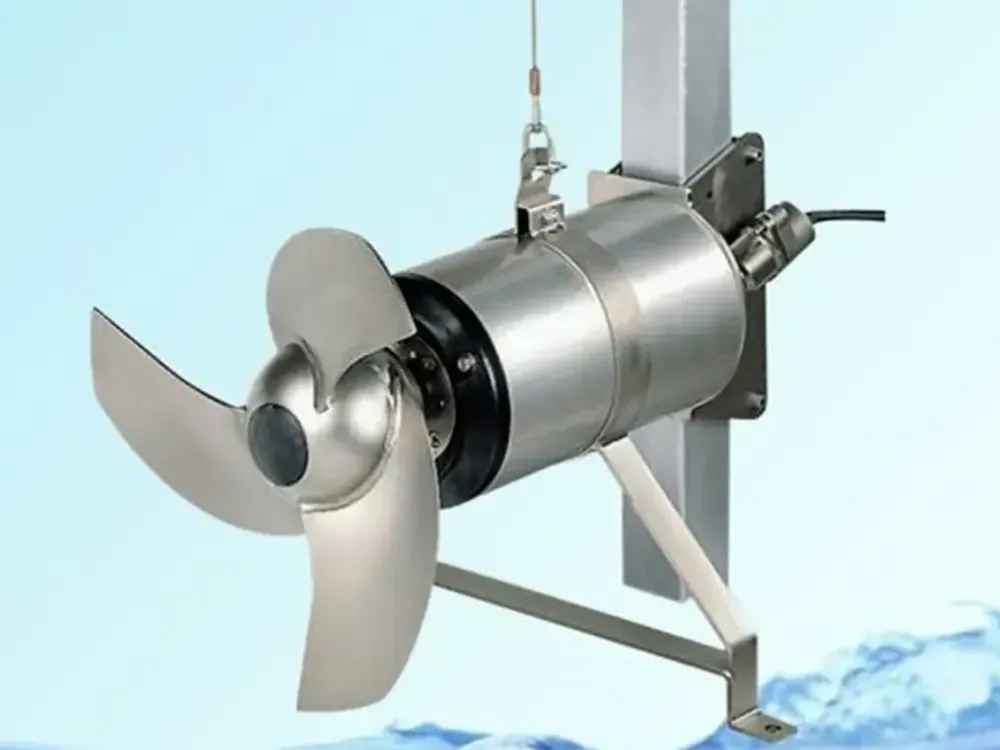
A submersible mixer uses a submerged propeller to move liquid within a tank. Its role is to create circulation and mixing rather than deliver liquid through a discharge pipe. A pump transfers liquid between locations, while an aeration system supplies oxygen. A treatment plant may need all three functions, but one equipment name doesn’t define the whole process.
For submersible mixer selection, write the intended task in plain language before choosing a model. “Keep suspended solids moving in this tank” is more useful than “supply a powerful mixer.” The first statement shows a result that the designer can discuss; the second leaves the duty open.
Decide whether your main need is to blend incoming streams, maintain solids in suspension, or drive circulation along a flow path. List any separate oxygen requirement. This helps avoid specifying a mixing solution for a problem that also needs a process change or different equipment.
If your project combines these duties, review the roles of mixers and sewage pumps in wastewater plants. Keep each item’s required function visible in the equipment schedule.
Describe the tank’s purpose
The name of the tank gives context, but the design brief needs more detail. An equalization tank receives changing inflows. An anoxic tank has a defined biological process duty. A sludge holding tank has its own liquid and solids conditions.
Use the actual operating case, not a general application label, as the basis for the discussion.
| Tank or process context | Question to answer before comparing equipment | Information to include |
|---|---|---|
| Equalization | What must remain uniform as inflow changes? | Inflow pattern, liquid levels, and settling concerns |
| Anoxic process | What suspension and circulation does the process require? | Process duty, solids data, and restrictions on oxygen introduction |
| Sludge holding | What are the solids and liquid properties during storage? | Solids content, viscosity data, and expected changes |
| Circulation basin | Where must liquid travel, and what blocks that route? | Plan drawing, walls, channels, and obstructions |
| Industrial wastewater | Which substances affect materials or operation? | Chemical composition, temperature, and solids description |
Don’t turn this table into a fixed model chart. It organizes the questions for submersible mixer selection; it doesn’t specify a propeller, power rating, or quantity for every tank in a category.
Make the desired result observable
Ask how the project will judge the proposed system. Is the concern a visible deposit in one corner, a difference between sampling points, or an interrupted circulation path? Record the observation and the operating state in which it occurs.
Then agree with the designer on what evidence will be used at handover. A motor running without an alarm is one observation. It doesn’t, by itself, show that the required mixing duty has been achieved across the tank.
For a settling concern, review the guide to mixers and sludge suspension when describing the problem and the tank conditions.
Illustrative scenario: A buyer replaces a failed mixer with another unit of the same rated power. The new unit fits the electrical supply, but a new partition has changed the tank layout. The useful next step is to update the layout and duty brief, rather than assume that the old power rating still defines the solution. This is a planning example, not a reported customer project.
That distinction keeps submersible mixer selection tied to the job the equipment must do. Preserve the observations, drawing revision, and operating conditions so each supplier works from the same starting point.
Collect Tank and Liquid Data Before Comparing Models
Draw the operating tank, not just its outer dimensions
A tank drawing should show the liquid volume in use and the space available for equipment. Record length and width, or diameter, together with the operating water depth. Include the lowest and highest intended liquid levels if those differ during normal service.
Submersible mixer selection also needs the features inside and above the tank. Mark dividing walls, columns, pipework, inlets, outlets, and other equipment. Show the access hatch, lifting position, and the route used to remove the mixer for service.
A rectangular tank’s nominal liquid volume can be written as length × width × liquid depth. That calculation describes volume. It doesn’t determine required thrust, the number of units, or whether the selected arrangement reaches every part of the basin.
The same point applies to a circular tank. A volume figure leaves out the details of the flow path and equipment placement. Keep the plan and section drawings with the volume calculation so the supplier can see what the number represents.
Record liquid properties and their range
Describe what the mixer will encounter during operation. “Wastewater” is too broad to settle material, propeller, or service questions. Supply the available data on solids, fibers, grit, liquid density, viscosity, temperature, and chemical composition.
For submersible mixer selection, distinguish measured values from assumptions. If a laboratory result represents one sample, show its date and sampling point. If the process team expects a wider range, include that range separately rather than treating one reading as the full design case.
Explain changes that occur during start-up, storage, cleaning, or a process upset. The supplier can then show which cases need further assessment. A missing value is a reason to request data, not a reason to fill the field with a convenient default.
A shared input sheet for submersible mixer selection
| Input group | Details to provide | Why the question belongs in the brief |
|---|---|---|
| Submersible mixer selection duty | Suspension, blending, circulation, and any separate aeration need | Defines the result to be discussed |
| Tank geometry | Plan dimensions, liquid depth, partitions, and obstacles | Shows the space and flow route |
| Liquid levels | Normal, minimum, maximum, and expected variation | Allows installation conditions to be reviewed |
| Liquid and solids | Composition, solids content, viscosity, fibers, and grit | Supports hydraulic and material review |
| Operating range | Temperature, pH, and changes during use | Allows the proposed model’s limits to be checked |
| Site services | Voltage, frequency, control interface, and cable route | Defines electrical and control needs |
| Access | Hatches, lifting route, service space, and retrieval method | Shows how the equipment will be maintained |
| Project scope | New installation, replacement, or retrofit | Identifies what must fit existing equipment |
This sheet gives submersible mixer selection a consistent basis. Attach drawings and reports instead of squeezing their details into a short purchase description.
Mark what is known and what still needs checking
Give each field a clear status:
- Confirmed: The value has an agreed source.
- Draft: The team still needs to check an assumption.
- Missing: Name the person who will supply the data.
Keep the source or next action beside the field. A draft value should stay marked until someone checks it.
For a replacement, attach the model plate and service record, then name the reason for the change. Is the unit broken, has the process changed, or is sludge collecting in one area? The answer defines whether the team is reviewing a replacement unit or a wider mixing problem.
Close this stage of submersible mixer selection with one agreed input sheet and drawing revision. Mark alternatives separately. A quote based on different liquid levels cannot be compared fairly until those inputs match.
Compare Thrust and Power in Submersible Mixer Selection
Read the units before ranking the numbers
Thrust describes the force produced by the mixer to move liquid and is expressed in newtons (N). Power is expressed in kilowatts (kW). Propeller diameter and rotational speed add further data about the proposed unit. These values describe different aspects of the equipment, so a larger number in one column is not a complete selection rule.
Wilo’s explanation of mixer thrust distinguishes this force from pump head and pressure. In submersible mixer selection, use that distinction to ask for the performance data relevant to mixing rather than treating the unit as a transfer pump.
Check what the power column means. Rated motor power is not automatically a measured electrical input under the proposed operating conditions. A table that gives rated kW and thrust does not, on its own, establish the operating energy use or hydraulic efficiency.
Compare published Kairun model rows
The following values appear in Kairun’s published mixer specification table. They are catalog observations, not independent test results or recommendations for a particular tank. Confirm the model, document revision, and applicable operating conditions with the supplier before ordering.
| Model | Rated power | Published “Water pushing” | Propeller diameter | Speed |
|---|---|---|---|---|
| QJB0.37/6-220/3-980/S | 0.37 kW | 138 N | 220 mm | 980 r/min |
| QJB4/6-400/3-980/S | 4 kW | 1,100 N | 400 mm | 980 r/min |
| QJB4/12-620/3-480/S | 4 kW | 1,200 N | 620 mm | 480 r/min |
Source: Kairun’s published technical parameters, checked October 12, 2026.
The two 4 kW rows show why power alone is incomplete. The published thrust, diameter, and speed differ. They give you questions to ask during submersible mixer selection, but they don’t establish which model will serve your tank better.
Use the published rows to start a comparison, then work through these review points. Submersible mixer selection does not end at the largest thrust figure.
| Review point | If the answer is clear | If the answer is missing |
|---|---|---|
| Same duty and tank data? | Compare the offers against the agreed input sheet. | Return the conflicting inputs for correction. |
| Same meaning of power and thrust? | Review the values and stated test conditions. | Request definitions and supporting data. |
| Exact propeller and drive identified? | Match the data to the quoted model. | Keep the option provisional until identified. |
| Layout fits the tank and access route? | Review the proposed arrangement with the designer. | Resolve the drawing or retrieval gap. |
| Limits cover the stated medium? | Record the approved service conditions. | Leave the condition open for written assessment. |
For the two 4 kW rows, the first useful decision is therefore not “choose 1,200 N.” It is “which proposal has data and a layout that address our duty?” Keep the comparison sheet with the equipment schedule so a later replacement can be checked on the same basis.
Test evidence for submersible mixer selection
ISO 21630:2007 covers acceptance test methods for submersible mixers used in wastewater and similar applications. Refer to the standard’s scope when asking about a test document. Its existence does not prove that a specific product has been tested to it.
Where test evidence is required, the submersible mixer selection record should name the method, measured quantities, and exact model. Distinguish a test report from a supplier declaration. Neither a general quality certificate nor a pump test-facility photograph answers those mixer-specific questions.
Keep draft calculations in their proper role
Power divided by liquid volume gives a power-density figure, often written as W/m³. It can describe a proposed arrangement, but it leaves out the flow path, propeller data, and placement. Treat it as one input to discuss, rather than a rule that chooses the model.
When reviewing submersible mixer selection, ask where any proposed calculation method and coefficients come from. Record the assumptions and the limits of its use. A calculation that cannot be traced to appropriate design data should not become the sole purchase basis.
Need help with submersible mixer selection? Send Kairun your tank drawings and duty needs together with the model rows you are considering. Ask for the proposed arrangement, operating limits, and included equipment in the response.
Review Drives, Propellers, Quantity, and Position Together
Separate the drive structure from speed control
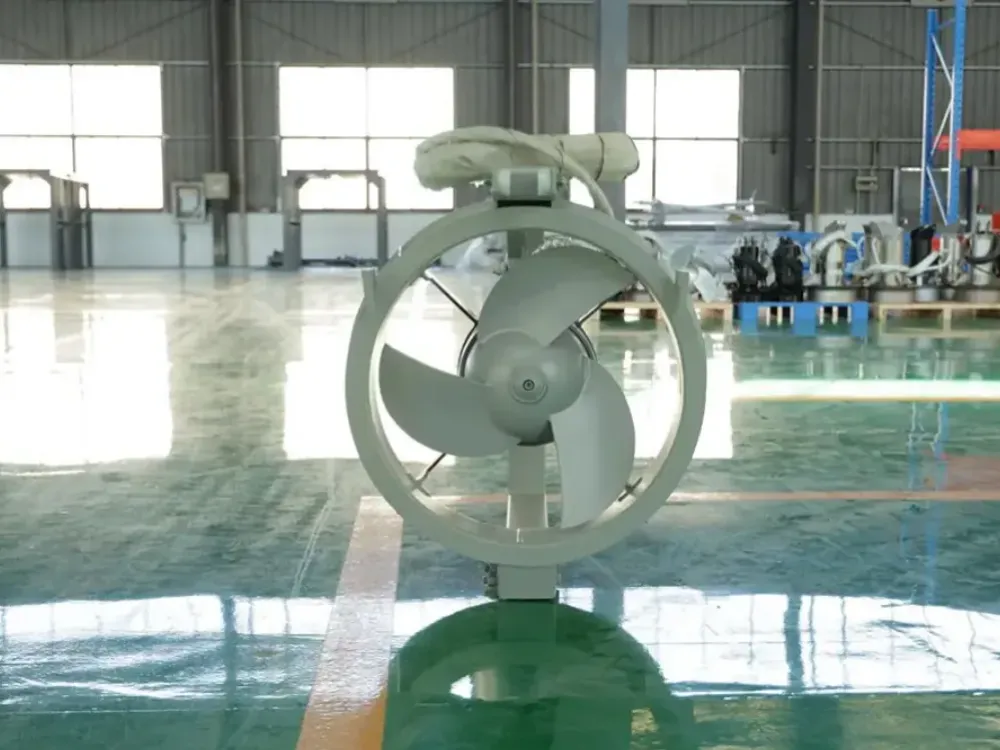
Direct drive describes a connection between the motor and propeller without a reduction gearbox. A geared arrangement uses a gearbox in the drive train. A variable frequency drive (VFD) is an electrical control device; it is not another name for a gearbox.
Keep those distinctions clear during submersible mixer selection. Ask which mechanical arrangement the quoted model uses, what speed data apply, and whether variable-speed operation is supported. Do not assume that adding a VFD is suitable for every existing unit.
For a retrofit, record the current supply, control panel, protection arrangements, and operating method. Request model-specific needs for any change. A proposal should explain both the equipment and the control scope, rather than simply promise “smart operation.”
Propeller checks for submersible mixer selection
Read the propeller, speed, thrust, and drive data as one configuration. In submersible mixer selection, a photograph or a familiar blade name cannot replace the exact model description.
| Item to compare | Required detail in the proposal |
|---|---|
| Propeller | Diameter, specified design, and supplied material |
| Drive | Direct or geared arrangement for the exact unit |
| Speed | The stated operating speed and any approved control range |
| Mounting | The arrangement shown on the project layout |
| Alternative | A separate model line with the changed features identified |
Use this comparison to make changes visible. If a supplier offers an alternative, show which rows differ and which requirements remain unchanged. A feature demonstrated on another brand’s mixer cannot be credited to the quoted model.
Plan the flow route and the service route
Review the working route and the retrieval route together. The working route follows the proposed liquid circulation past the tank’s inlet, outlet, partitions, and other equipment. The retrieval route follows the mixer from its installed position through the hatch to the inspection area.
This conceptual map organizes submersible mixer selection. It is not a flow simulation or an installation drawing, and it specifies no angle, clearance, model count, or performance result.
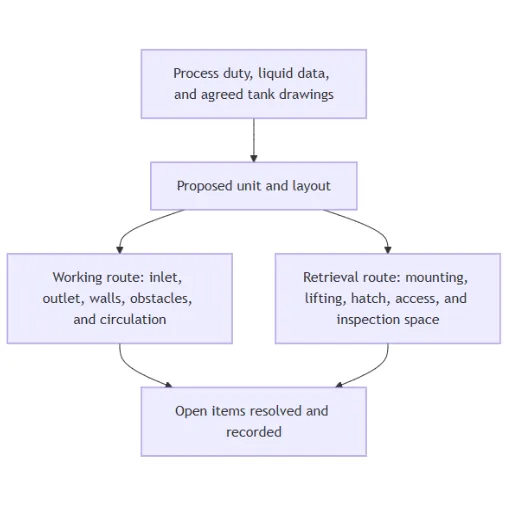
Use the map to organize a layout review, then record the project-specific details on the actual drawings. Keep any proposed angle or clearance provisional until the responsible designer and supplier have checked it.
Illustrative scenario: A retrofit proposal places a mixer beside an existing column. The purchase team checks the motor and material, but the maintenance team notices that the lifting path crosses fixed pipework. A layout review allows the team to resolve the access conflict before ordering. No installed performance or customer result is implied by this example.
Check Operating Limits, Service Access, and Ownership Cost
Confirm limits for the quoted model
Kairun’s published operating guidance lists a maximum medium temperature of 40°C and a pH range of 5–9. Use these as published starting points for a model-specific discussion. They do not establish compatibility with every chemical mixture within that pH range.
During submersible mixer selection, provide the liquid composition and any changes in temperature or chemistry. Ask for written confirmation that the quoted setup matches the stated operating conditions. Identify which parts contact the liquid and what material is supplied for each.
If your service falls outside the published guidance, describe it directly. Don’t treat a general statement about special designs as confirmation that a particular setup has already been approved for the duty.
Compare materials using the actual medium
A material label alone is not a full compatibility assessment. Include the substances present, concentrations where known, and the operating range. Describe grit and fibers separately from chemical conditions so the supplier can address the different concerns.
Use a parts-level material list in submersible mixer selection: propeller, housing, mounting parts, fasteners, and coatings. A “stainless steel mixer” headline doesn’t tell you which of those items it covers.
Next to that list, record the stated service range and exclusions. For example, distinguish the process liquid from a cleaning chemical if both contact the unit. An unassessed condition remains open; it is not approved service.
Make maintenance access part of the purchase decision
Ask for the retrieval arrangement, inspection needs, and model-specific maintenance instructions. Check who supplies guide rails, lifting equipment, brackets, and cables. Confirm which items are included in the installation scope and which must be provided at site.
Make the handover document list part of submersible mixer selection. Include the model identification, parts data, operating instructions, and the inspection records required by the project. Use the selected model’s maintenance schedule rather than one generic interval.
Keep fault records distinct from mixing observations. An alarm or unusual sound belongs in the equipment record; a deposit and its operating conditions belong in the process observation log. They may be related, but one does not prove the cause of the other.
Compare cost on a consistent equipment scope
Purchase price is one line in the comparison. Installation items, controls, service access, spare parts, and energy data belong on their own lines. Ask each supplier to state what is included and what remains outside the quote.
Xylem’s discussion of wastewater mixing challenges treats size, position, energy use, and monitoring as related decisions. For your own comparison, request project-specific evidence rather than transferring another brand’s savings or control features to the proposed unit.
For an energy-cost comparison, name the electrical input data, hours, and tariff used. Mark each as measured or assumed, and use the same basis for each offer. Submersible mixer selection cannot turn rated motor power alone into a promised energy bill.
Build a Reviewable RFQ and Selection Record
An RFQ for submersible mixer selection
A request for quotation (RFQ) should allow the supplier to propose equipment against the same data the project team uses. Attach the design-input sheet, current drawings, and the operating description. Mark unresolved fields instead of concealing them inside a broad equipment specification.
Use the following checklist to make submersible mixer selection easier to review:
- Duty: Describe the mixing task and how the project intends to assess it.
- Tank: Attach plan and section drawings with levels, walls, obstacles, inlets, and outlets.
- Medium: Provide composition, solids data, temperature, and other available properties.
- Services: State the electrical supply, control needs, and cable route.
- Access: Show the mounting, lifting, retrieval, and inspection space.
- Supply scope: List required accessories, documents, spares, delivery terms, and installation responsibilities.
- Evidence: Identify the performance or test documents the project requires.
Keep assumptions beside the recommendation rather than in a separate email thread. A submersible mixer selection record should show what each proposal depends on, such as a liquid property or final drawing revision.
Copy these fields into your RFQ and fill them with project data. This is a text template, not a sizing calculator or an advertised download service.
| RFQ field | Project entry |
|---|---|
| Submersible mixer selection duty | [State the mixing task and review method] |
| Tank drawing and revision | [Attach the agreed plan and section] |
| Liquid levels and properties | [Separate confirmed data from assumptions] |
| Proposed equipment scope | [List the unit, accessories, and controls required] |
| Required documents | [List performance, installation, and service documents] |
| Open item and owner | [Name the missing input and who will resolve it] |
Leave missing fields marked. If the quote changes after an input is confirmed, retain both revisions so the final decision can be followed.
Work through an incomplete input sheet
Illustrative scenario: A project team is preparing an equalization-tank RFQ. It has a rectangular tank drawing, normal liquid level, and supply voltage, but the solids data and lowest operating level are still draft. Instead of requesting a final model from the tank volume alone, the team asks its process designer to confirm those inputs and marks the supplier’s first proposal as draft.
The example stops at the data decision. It does not specify a mixer count, model, or energy saving. Its purpose is to show how submersible mixer selection can proceed without presenting an assumption as a confirmed design input.
Create a short question log for that project. One question concerns operating levels; another concerns liquid properties; a third concerns the layout. Close each item with a document reference or written answer so the final purchase record is traceable.
Compare proposals line by line
| Comparison field | What the supplier should show | What your team should check |
|---|---|---|
| Submersible mixer selection model | Exact model and setup | Matches the quoted documents |
| Performance data | Thrust, power definitions, and supporting conditions | Values are compared on a clear basis |
| Layout | Quantity, position, and mounting arrangement | Uses the current tank drawings |
| Operating limits | Applicable medium and service conditions | Covers the stated operating range |
| Accessories | Included rails, brackets, cables, and controls | No hidden gap in installation scope |
| Service documents | Instructions, parts data, and required records | Available for the supplied model |
| Open items | Assumptions, exclusions, and required confirmations | Resolved before final approval |
Keep the final submersible mixer selection sheet with the purchase documents. If the model changes later, return to the same needs and compare the replacement explicitly. A different power rating or a similar product name is not a complete replacement review.
Submersible Mixer Selection FAQs and Next Steps
Is tank volume enough to choose a submersible mixer?
No. Volume tells you how much liquid the tank holds. It doesn’t show the flow path, walls, or mixing task. Submersible mixer selection needs those details, the liquid data, and the proposed equipment.
Is W/m³ a complete sizing method?
No. A power-density figure records power relative to liquid volume. It leaves out the setup and layout needed to discuss mixing across the tank. Ask for the basis of any sizing method and its assumptions before using it as a purchase requirement.
Does higher rated power mean better mixing?
Not by itself. Kairun’s two published 4 kW rows above have different thrust, diameter, and speed values. Submersible mixer selection should compare the relevant data and project fit, rather than rank units by motor power alone.
How many mixers does one tank need?
Review the number with the duty, tank layout, liquid data, and proposed units. Tank volume alone won’t settle it. Ask for a drawing and the basis of the choice, then have the project designer check both.
Can a VFD be added to an existing mixer?
Confirm compatibility with the manufacturer for the exact unit and drive arrangement. Include the supply, controls, operating method, and required protections in the question. Submersible mixer selection for a retrofit should cover those interfaces, not just the new electrical device.
Can one mixer serve every wastewater application?
Do not assume so. Compare the quoted model’s limits and setup against the actual medium and process duty. A product family covering different applications does not mean that every model or material option is interchangeable.
What should I send before asking for a model recommendation?
Send the tank drawings, operating levels, mixing task, liquid and solids data, electrical supply, and access constraints. Include existing equipment details for a retrofit. Mark missing data so the supplier can explain what remains draft in the proposal.
Move from a shortlist to a confirmed proposal
Good submersible mixer selection produces a record that another engineer or buyer can follow. It connects the duty to the inputs, the inputs to the proposed arrangement, and the arrangement to the documents required for installation and service.
Keep the original questions visible until they are resolved. Use the same comparison sheet for alternatives, and check that the final model, accessories, and limits match the agreed design case. That makes the decision useful beyond the day the quote arrives.
Ready to prepare a proposal? Send Kairun your tank drawings and mixing duty, including the available operating data and open questions. You can also review the wastewater treatment equipment range when defining the wider project scope. Use this submersible mixer selection checklist to keep the request specific and the supplier’s response reviewable.