Choosing an industrial water pump system requires more than checking flow and head ratings. The actual duty point, fluid conditions, installation method, and operating schedule all affect pump performance and service life.
This guide explains how to calculate flow and head, select the right pump type, improve efficiency, and design for reliable continuous operation.
1. Define the Required Flow and Head
1.1 Start With the Actual Flow Rate
The required flow should be based on process demand rather than the pump’s maximum capacity.
First, determine the normal flow. Then check the minimum and peak flow if demand changes during operation.
Important data includes:
· Normal flow
· Minimum flow
· Peak flow
· Operating hours
· Continuous or intermittent duty
Oversizing should be avoided whenever possible. A pump that is much larger than required may operate outside its suitable range.
This is especially important when a high capacity water pump is used for a process with changing demand.
1.2 Calculate the Total Head
Flow tells you how much liquid must be moved. Head indicates the energy required to move it.
The required head should account for:
· Static elevation
· Pressure difference
· Pipe friction
· Valves and fittings
· Filters or other flow restrictions
A simple calculation is:
TDH = Static Head + Pressure Head + Friction Head
The actual piping layout should be used for the calculation. Pipe length, diameter, surface condition, and fittings can all affect pressure loss.
The pump should then be selected according to the required flow at the calculated total head.
1.3 Check the Pump Curve and Operating Point
A pump curve shows the relationship between flow and head. A system curve shows how much head is required at different flow rates.
The actual operating point is where the two curves intersect.
The U.S. Department of Energy recommends evaluating the pump curve together with piping conditions rather than selecting a pump only by its maximum rated flow or head. DOE also identifies operation near the best efficiency point, or BEP, as an important factor in pump efficiency.
For buyers, this means the duty point matters more than the maximum catalog value.
2. Select the Right Pump Type
2.1 Match the Pump to Flow and Head
| Pump Type | Typical Hydraulic Duty | Common Applications |
| Centrifugal pump | Flexible flow and head | General water transfer |
| Axial flow pump | Very high flow, low head | Drainage and flood control |
| Mixed flow pump | High flow, moderate head | Irrigation, drainage, water transfer |
| Positive displacement pump | Controlled flow, higher pressure | Specialized process duties |
| Submersible pump | Direct submerged operation | Wells, sumps, drainage |
Different pump designs suit different hydraulic conditions.
The selection should start with the actual duty point. Installation conditions should also be considered.
2.2 When Is a Mixed Flow Pump Suitable?
A mixed flow pump sits between radial-flow and axial-flow designs. Its impeller develops both radial and axial components of flow.
As a result, mixed flow pumps are generally used when a relatively large flow is required at a moderate head. Wiley’s technical reference on mixed-flow pumps describes them as pumps with characteristics of moderate head and large flow rate.
There is no single universal flow or head range for all mixed flow pumps. The actual range depends on impeller design, speed, size, and specific speed.
This makes the pump type suitable for applications such as irrigation, drainage, water transfer, and some industrial water duties.
2.3 When Does a Submersible Design Make Sense?
A submersible pump can operate directly in the liquid. This makes it useful for sumps, tanks, drainage structures, and other submerged locations.
For wet installations, motor protection becomes particularly important. The installation should also be checked for water level, access, lifting, cable routing, and maintenance.
3. Design for Continuous and Reliable Operation
3.1 Match the Pump to the Duty Cycle
A pump that runs continuously should be selected differently from one used for short periods.
The normal operating point should be checked first. Peak flow should also be considered if demand changes significantly.
For continuous operation, buyers should review:
· Normal flow
· Minimum flow
· Peak flow
· Operating hours
· Start-stop frequency
· Fluid temperature
· Solid content
3.2 Keep the Pump Near Its Suitable Operating Range
Pump performance can change when the operating point moves too far from the design condition.
The Hydraulic Institute explains that operation away from the preferred operating region can increase the potential for flow recirculation, vibration, cavitation, and additional hydraulic loading.
This is why an oversized heavy duty industrial water pump is not automatically a better choice.
A correctly sized pump can reduce unnecessary throttling. It can also support more stable operation.
3.3 Check NPSH and Cavitation Risk
NPSH should be checked when suction conditions may create a risk of cavitation.
NPSHa represents the available net positive suction head. NPSHr represents the value required by the pump under specified operating conditions.
Liquid temperature is important because vapor pressure rises as temperature increases. Suction losses can also reduce available NPSH.
The Hydraulic Institute recommends considering NPSH margin together with the pump’s operating region when evaluating pump reliability.
The required margin should therefore be determined from the actual pump, fluid, and operating conditions rather than from one fixed value.
3.4 Consider the Fluid Before Choosing Materials
Industrial water may contain more than clean water.
Depending on the application, it may contain suspended solids, abrasive particles, or corrosive components.
Material selection should therefore consider:
· Temperature
· pH
· Corrosive components
· Solid content
· Abrasive particles
· Operating time
For abrasive service, wear-resistant materials may help reduce erosion of the flow components. Corrosive media may require stainless steel or another suitable material.
4. Improve Energy Efficiency
4.1 Avoid Unnecessary Oversizing
A larger motor does not automatically mean better pump performance.
If a pump is oversized, its flow may be controlled with a valve. This can create unnecessary pressure loss and increase energy consumption.
DOE guidance emphasizes matching pumps to actual requirements and evaluating the complete pumping arrangement rather than focusing only on individual equipment ratings.
The better approach is to start with the actual flow and head. A pump can then be selected to match the duty point.
4.2 Use Variable Speed When Flow Changes
Variable-frequency control can be useful when flow requirements change frequently.
For centrifugal and mixed flow pumps under appropriate similarity conditions, the basic affinity relationships are:
· Flow ∝ Speed
· Head ∝ Speed²
· Power ∝ Speed³
DOE materials use these relationships to explain how pump speed affects flow, head, and power.
For example, reducing speed to 80% gives an idealized power ratio of:
0.8³ = 0.512
This is a theoretical relationship rather than a guarantee of actual energy savings. Pump efficiency, minimum operating speed, motor characteristics, and piping conditions still need to be checked.
4.3 Consider Long-Term Operating Cost
For continuous-duty equipment, the purchase price is only part of the cost.
Energy consumption can become a major expense when a pump runs for long periods. Maintenance and replacement costs should also be considered.
A simple lifecycle calculation is:
Lifecycle Cost = Purchase Cost + Energy Cost + Maintenance Cost + Replacement Cost
5. Specify Materials, Protection, and Testing
5.1 Select Materials for the Actual Medium
The same pump material may not suit every liquid.
For clean water, standard materials may be sufficient. For wastewater or abrasive slurry, wear-resistant components may be more suitable.
For corrosive liquids, stainless steel or another suitable corrosion-resistant material can be selected according to the actual medium.
5.2 Check Motor and Seal Protection
Submerged operation creates additional requirements for motor protection.
Depending on the pump design and application, buyers should check:
· Motor protection rating
· Insulation class
· Mechanical seal arrangement
· Oil chamber protection
· Cable protection
· Anti-condensation measures
These features should be selected according to the installation environment rather than treated as universal requirements.
5.3 Define Testing and Documentation
Testing requirements should be agreed before production.
Depending on the application, buyers may request:
· Performance curves
· Installation and operation manuals
· Material information
· Certification documents
· Factory test records
The required documents should match the application and applicable project specifications.
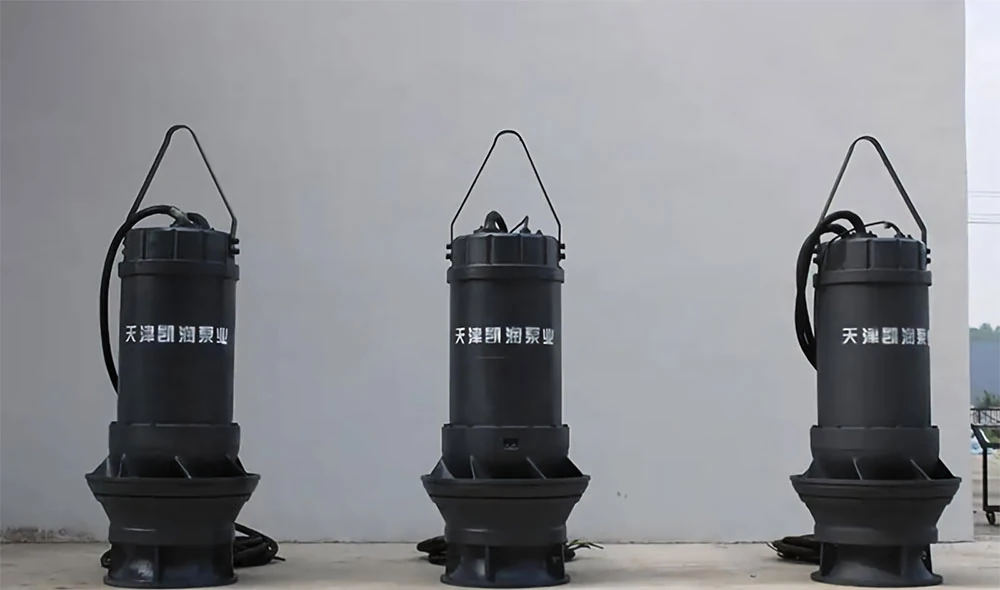
6. Kairun Submersible Mixed Flow Pump for High-Flow Water Handling
Kairun provides submersible mixed flow pumps for high-flow applications with low to moderate head requirements. The pump operates underwater, so a large dry pump room is not required.
It is designed for projects where water levels change quickly or installation space is limited.
6.1 Flow, Head, and Motor Options
Kairun’s submersible mixed flow pump covers a wide range of high-flow applications. The main specifications are shown below.
| Parameter | Specification |
| Flow | 500–20,000 m³/h |
| Head | 3–22 m |
| Speed | 590 / 740 / 980 r/min |
| Motor power | 15–800 kW |
| Voltage | 380 V / 660 V / 6 kV / 10 kV |
| Frequency | 50 Hz |
| Motor protection | IP68 |
| Insulation class | F / H |
| Medium temperature | ≤50°C |
| Pump efficiency | Up to approximately 85% |
| Solid passage | Approximately 5–20 mm |
This range allows the pump to be selected according to the actual flow and head requirements. Different motor power and voltage options are available for larger pumping projects.
6.2 Mixed Flow Impeller and Submersible Motor
The mixed flow impeller produces both radial flow and axial thrust. This design allows the pump to handle large water volumes at moderate head.
The motor is directly coupled to the pump and operates fully submerged. Two mechanical seals with SiC friction pairs protect the motor from the pumped water. An oil chamber provides an additional barrier.
The motor also has thermal overload, water leakage, and dry-running protection. These functions help protect the motor during operation.
6.3 Materials and Protection
The flow components can be made from cast iron, SS304, SS316, or high-chrome alloy.
Material selection depends on the water quality. SS304 or SS316 can be used when mild corrosion is a concern. High-chrome alloy is available when better wear resistance is required.
A guide rail installation is also available. The pump can be lifted from the basin for inspection without draining the water first.
7. Case Study: Submersible Mixed Flow Pumps for Flood Control
A coastal city needed to upgrade a flood control pumping station. The station had to handle up to 6,000 m³/h of rainwater during heavy storms.
The water level changed quickly during rainfall. Space was also limited, so building a large dry pump room was not practical.
The Original Problem
The station used dry-installed centrifugal pumps. These pumps required deep dry pits.
During severe weather, the pits faced a flooding risk. Maintenance also took several days because the equipment was difficult to access.
The Pumping Solution
Three submersible mixed flow pumps were installed. Each pump used IP68 protection with a guide rail lifting arrangement.
Automatic level control was added to manage changing water levels. Parallel operation provided backup capacity when one pump was unavailable.
Because the pumps were installed underwater, no large dry pump room was required. The units could also be lifted from the basin without first draining it.
Reported Results
During heavy rainfall, the pumping station achieved unattended continuous operation.
| Project Result | Reported Improvement |
| Site area and civil construction cost | Reduced by approximately 40% |
| Maintenance time | Reduced from several days to several hours |
| Energy use per unit volume | Reduced by approximately 15% |
| Operation during heavy rainfall | Unattended continuous operation |
The reported results show how submerged installation can simplify maintenance when a pumping station has limited space or changing water levels.
FAQ
How Can the Required Flow and Head Be Determined?
First, define the process requirements. Then calculate the static head, pressure difference, and pipeline losses. The actual operating point obtained from these calculations can be used for pump selection.
Which Applications Are Suitable for Mixed Flow Pumps?
Mixed flow pumps are suitable for applications requiring high flow rates and moderate head. Common applications include irrigation, drainage, water transfer, and some industrial water duties.
Can a 60 Hz Motor Be Connected to a 50 Hz Power Supply?
The motor voltage and frequency must be checked before use. When a 60 Hz motor operates on a 50 Hz power supply, the speed will decrease. Therefore, the available power, flow rate, and head must be confirmed.
How Should a Mixed Flow Pump Be Maintained?
Regular inspections should include the mechanical seal, bearings, impeller, motor protection, and wear components. The recommended maintenance schedule should follow the manufacturer’s operation and maintenance instructions.
Can the Pump Be Customized?
Yes. Pumps can be customized according to flow rate, head, materials, voltage, connection requirements, temperature, and other application conditions. OEM services and project-specific pump selection support are also available.
Conclusion
A suitable industrial water pump system should match the required flow and head. Installation conditions also need to be considered when water levels change frequently.
For high-flow applications with low to moderate head, a submersible mixed flow pump can be a suitable choice. Its submerged installation is useful when space for a dry pump room is limited.
Kairun provides pumps with flow rates of 500–20,000 m³/h and heads of 3–22 m. Motor power is available from 15 to 800 kW, with multiple voltage options. Contact Kairun to discuss your operating conditions and request a suitable pump selection.