A complete guide for international buyers — how Stop Log and Sluice Gates protect your project, and keep your plant running safely and efficiently.
For international buyers in water supply, wastewater treatment, and flood control, the performance of a pumping or treatment plant depends not only on the pumps and equipment themselves, but on the flow-control valves and gates that direct, isolate, and regulate water throughout the system. Gates are the mechanical “switches” that work hand-in-hand with pumps and treatment processes — enabling safe maintenance, precise flow management, and reliable plant operation.
This article focuses on the two most widely used gate types in water engineering — Stop Log (Z-type steel) gates and Sluice Gates (SYZ / SFZ series) — and explains how they integrate with pumping and water treatment systems.
Why Gates Matter in Pump and Treatment Plants
Every pumping station and treatment facility faces the same core challenge: controlling where water goes and when. Gates provide this control at key points:
Isolation for maintenance — Gates seal off pump intakes, tanks, and channels so equipment can be serviced without draining the entire system.
Inlet and outlet regulation — Gates modulate flow into and out of pump basins and treatment units, protecting pumps from dry-running, surging, or overcapacity.
Emergency protection — In flood events or pipe failures, gates shut off flow instantly to safeguard pumps, processes, and surrounding infrastructure.
Process flexibility — By dividing channels and basins, gates allow operators to switch treatment lines on and off, adapting to fluctuating inflow.
In short, gates are the boundary layer of a pumping or water treatment system: they make the system safe, controllable, and maintainable.
Stop Log Gates (Z-type Steel Series) — Retention and Isolation
Stop Log gates are water retention structures designed to temporarily block water flow. The Z-type series steel stop logs are built with a steel-frame skeleton and multi-layer gate plates, providing high structural rigidity and flexible configuration.
Key Characteristics
Modular, stackable design — Individual logs are stacked into the gate slots to achieve the required height, so the effective dam height can be adjusted to match water levels or maintenance needs.
High rigidity under hydrostatic pressure — The multi-layer plate design maintains stable deformation control even under substantial water head, ensuring dependable sealing.
Wide application — Ideal for pump intake screens, clarifier and tank isolation, channel maintenance, reservoir and sluice inspection openings, and temporary barriers during construction or repair.
In pumping and treatment plants, stop logs are commonly used to dewater a pump bay or a treatment basin for inspection and servicing — allowing crews to work safely while the rest of the plant keeps running. Their simple, robust construction also makes them cost-effective and easy to install without heavy lifting equipment.
Sluice Gates (SYZ / SFZ Series) — Flow Regulation and Precise Control
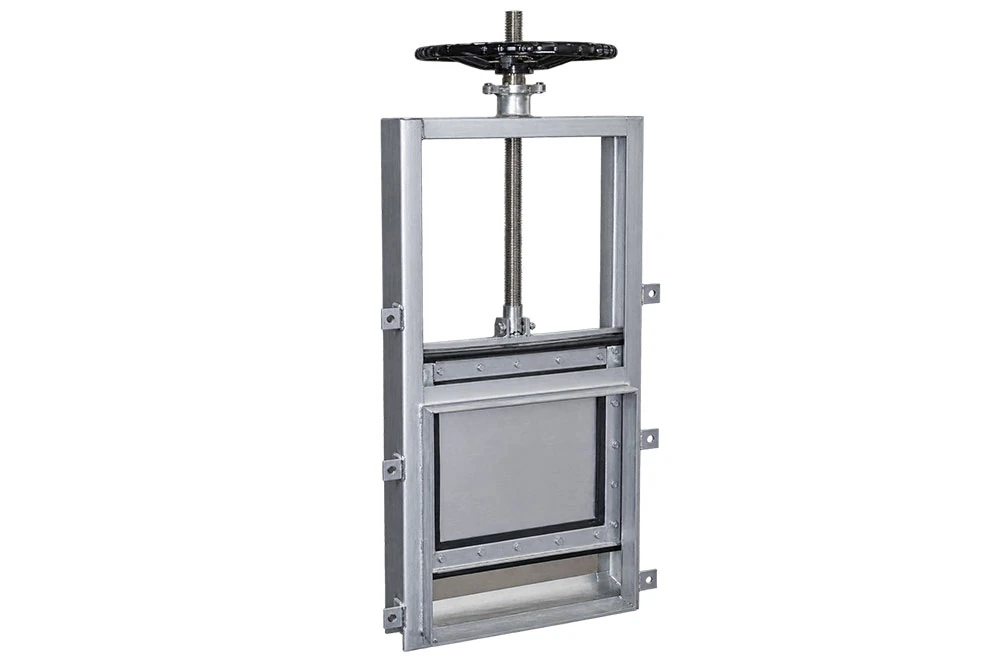
Sluice Gates are flow-regulating devices used to precisely control the passage of water through an opening. The SYZ and SFZ series feature a monolithic metal gate panel lifted and lowered by a hoisting mechanism (handwheel, electric actuator, or hydraulic cylinder) to vary the flow area.
Key Characteristics
Precise flow control — The gate leaf can be positioned at any height, giving operators accurate, stepless regulation of discharge — critical for matching pump output to demand.
Fast, smooth operation — Rapid opening and closing response, ideal for frequent duty cycles and emergency shutoff.
Reliable sealing — Tight sealing surfaces minimize leakage, reducing energy loss and protecting downstream equipment.
Versatile applications — Suited for river intakes, pump suction chambers, irrigation canal intakes, drainage and stormwater outlets, and process channel isolation in water and wastewater plants.
When paired with pumps, sluice gates control the water level in the suction basin, ensuring constant, cavitation-free suction conditions and stable pump efficiency. In treatment plants, they regulate flow between process units — such as from raw water intake to sedimentation — and isolate units for cleaning without halting the entire line.
How Gates and Pumps / Treatment Work Together
| Application | Gate Type | Role |
| Pump intake / suction basin | Sluice Gate | Regulate water level, maintain stable suction |
| Pump bay inspection & maintenance | Stop Log | Isolate and dewater the bay |
| Treatment tank / clarifier isolation | Stop Log | Block flow for cleaning and servicing |
| Channel / unit flow distribution | Sluice Gate | Divert and regulate flow between units |
| Storm / flood protection | Sluice Gate | Fast shutoff to protect pumps and plant |
The most effective systems combine both gate types:
By selecting the right gate for each function, plant operators achieve safe maintenance, efficient pumping, and uninterrupted treatment — all with lower downtime and operational risk.
Quality and Compliance
Kairun supply gates engineered to international standards, with:
Corrosion-resistant materials and proven coating systems (hot-dip galvanizing, epoxy) for long service life in water environments.
Precision manufacturing — CNC cutting and automated welding ensure dimensional accuracy and reliable sealing.
Custom sizing to match your channel, basin, and opening dimensions.
Options for manual, electric, or hydraulic actuation to suit your automation level.
Whether you are building a new pumping station, upgrading a treatment plant, or replacing aging gates, integrating reliable water gates with your pump and treatment systems is key to achieving safe, efficient, and maintainable water infrastructure.