Choosing the wrong gate can make routine flow control unnecessarily difficult—or leave a maintenance project without a practical way to isolate water. The challenge is that a sluice gate and a stop log gate can serve similar water control purposes while being designed for very different operating needs.
A sluice gate is suited to regular flow regulation, while a stop log gate is primarily used for temporary water isolation. In this article, we compare their structure, sealing, installation, materials, and typical applications to help you determine which option fits your project.
How Does a Sluice Gate Work?
A sluice gate uses a reinforced gate panel installed in a frame or gate groove. The panel has an integrated welded reinforcement structure to withstand water pressure. A stainless-steel trapezoidal screw raises and lowers the gate, and its self-locking function allows the gate to stay at any selected position. Sealing rubber around the panel helps prevent leakage, while the gate frame keeps the panel moving smoothly during operation.
One of the main advantages of a sluice gate is adjustable opening. Because the gate can stop at different positions, the operator can regulate water flow rather than simply opening or closing the passage. Depending on the configuration, the gate can be operated manually with a handwheel or electrically with a geared motor.
How Does a Stop Log Gate Work?
A stop log gate is made up of individual rectangular logs. Each log can be hollow or solid and is internally reinforced to improve its strength. The logs are stacked in the gate grooves one by one to form a temporary water barrier.
Each log has a lifting eye or lifting hole for handling. Depending on the application, the logs can be installed and removed manually or with an electric hoist. Composite rubber seals are fitted along the sides and ends of each log, while a bottom seal helps prevent leakage between the lowest log and the channel floor.
This modular design is well suited to temporary water isolation, as the logs can be removed and stored when they are no longer needed.
Sluice Gate vs Stop Log Gate: Key Differences
Flow Control and Operating Method
A sluice gate uses a single gate panel that moves up and down through a screw lifting mechanism. The gate can be held at different opening positions, allowing operators to adjust water flow as needed.
A stop log gate uses multiple logs that are stacked or removed one by one to create or remove a water barrier. It is generally used for water isolation rather than continuous flow regulation. Unlike a sluice gate, it is not designed for adjusting flow at different opening positions.
Operating Efficiency
A sluice gate can typically be opened or closed by turning a handwheel or using an electric drive. It can be operated by one person without removing the gate from the structure, making it suitable for frequent operation and quick flow control.
A stop log gate requires the logs to be installed or removed one by one. Depending on the log size and weight, the work may require two to three people or lifting equipment such as an electric hoist, and the installation and removal process generally takes longer than operating a fixed sluice gate.
Sealing Performance
Both gate types use rubber seals to limit water leakage, but their sealing arrangements are different.
A sluice gate uses a single gate panel with a continuous sealing structure around the panel. A stop log gate uses multiple logs with sealing components along the sides and ends of each section, as well as a bottom seal for the lowest log.
Because a stop log gate is made up of multiple sections, the condition and alignment of each log and its seals need to be considered during installation and maintenance. For both types of gates, water pressure, installation accuracy, seal condition, and debris or sediment can also affect actual sealing performance.
Initial Cost
A stop log gate generally has a simpler structure and does not require a permanent screw lifting mechanism. This can make it a more economical choice for applications where the gate is used only occasionally.
A sluice gate includes a fixed lifting mechanism in addition to the gate panel, frame, and sealing system, so its initial cost can be higher. However, the fixed mechanism allows the gate to be operated repeatedly without removing the gate itself.
Application Frequency
Sluice gates are generally suited to daily or frequent operation, especially where water flow or water levels need to be adjusted as part of normal system operation.
Stop log gates are better suited to temporary, seasonal, or low-frequency water isolation. They can be installed when a section needs to be isolated for maintenance, construction, or other temporary work and can remain in place for an extended period without regular operation.
When Is a Sluice Gate the Better Choice?
Municipal Wastewater Treatment
Sluice gates are suitable for applications such as inlet and outlet channels, aeration tanks, and sedimentation tanks where water flow needs to be controlled or sections need to be isolated for maintenance.
Their adjustable opening also makes them suitable for systems that require regular changes in flow.
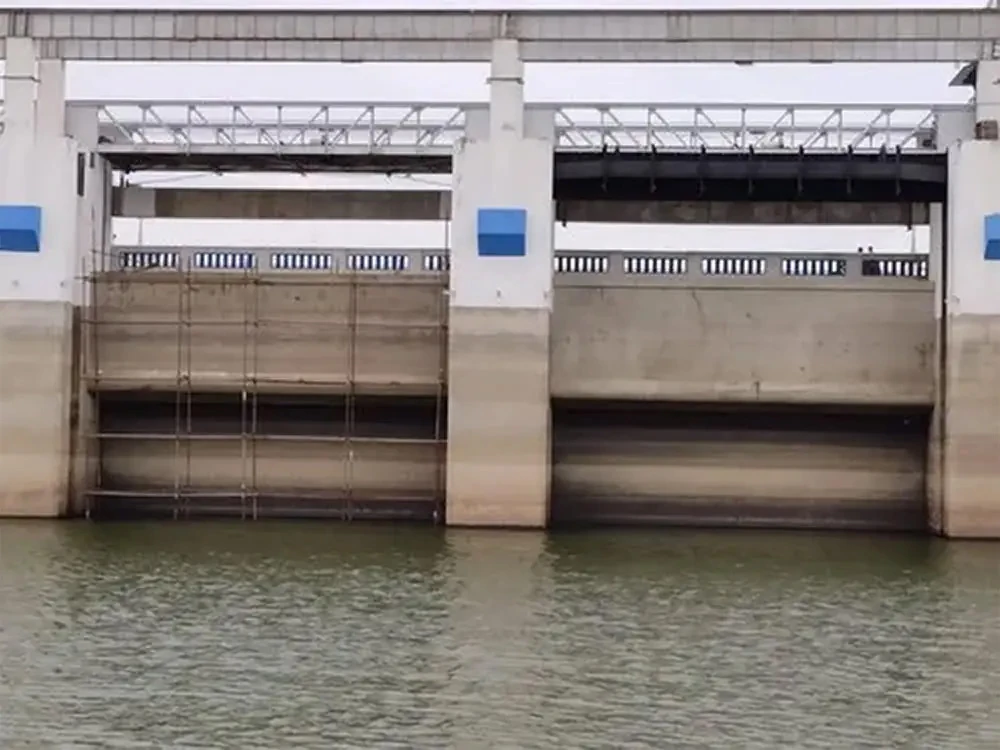
Water Treatment Plants and Pump Stations
At water treatment plants and pump stations, sluice gates can be used for water level and flow control in channels, pump rooms, and clear-water tanks.
Manual or electric operation can be selected according to the operating requirements.
Industrial Wastewater Treatment
Industrial wastewater facilities may involve water containing corrosive substances. Sluice gates can be configured with different materials according to the operating environment, including stainless steel and corrosion-protected carbon steel.
They can be used for water isolation and flow distribution in wastewater treatment systems.
Irrigation, Aquaculture, and Hydraulic Projects
Irrigation channels, aquaculture ponds, small reservoirs, and hydraulic structures may require regular adjustment of water flow.
In these applications, a sluice gate allows operators to adjust the opening and control the amount of water passing through. This makes it more suitable for systems that need regular flow adjustment.
When Is a Stop Log Gate the Better Choice?
Temporary Maintenance and Equipment Isolation
Stop log gates are suitable for temporary isolation during maintenance. They can be installed when a section of a reservoir, water conveyance system, pump station, or water treatment facility needs to be separated from the water flow.
After maintenance is completed, the logs can be removed and stored.
River and Channel Maintenance
During river dredging, channel maintenance, or lining work, temporary water isolation may be required. Stop logs can provide a removable barrier without requiring a permanently operated gate for the entire maintenance period.
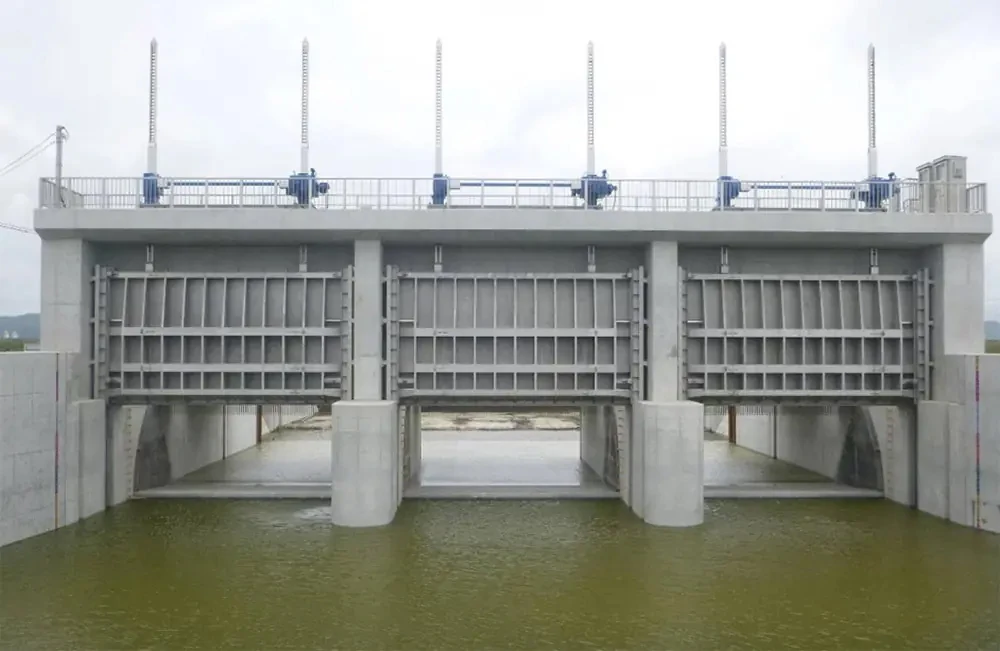
Flood Protection and Temporary Water Barriers
A modular stop log system can also be used as a stop log flood barrier for temporary flood protection or emergency water isolation where the project conditions are suitable.
Because the logs can be stacked and removed, the system can also be used seasonally.
Construction and Temporary Diversion
During hydraulic construction, temporary diversion and phased water isolation may be required. Stop logs can serve as temporary barriers for construction-stage water control when the project layout allows for their installation and removal.
What Should You Consider Before Choosing a Gate?
Start With the Purpose of the Gate
Start by defining what the gate needs to do. If the system requires regular flow regulation, frequent opening and closing, or adjustable water levels, a sluice gate is generally a better fit. If the main purpose is to isolate water during maintenance, construction, seasonal operation, or other temporary work, a stop log gate is usually more suitable.
Check Water Head and Sealing Requirements
Water head is one of the first technical factors to check. The gate should be selected according to the expected water depth and pressure at the site.
Sealing requirements are also important, especially where water leakage needs to be limited. Consider the required leakage level, the direction of water pressure, the sealing arrangement, and how easily the seals can be inspected or replaced.
Evaluate Installation and Handling Conditions
Consider how the gate will be installed, operated, and removed at the site. A sluice gate is normally installed as a fixed structure and operated through its lifting mechanism.
A stop log gate requires individual logs to be installed or removed when the water barrier needs to be changed. This means the site should have enough working space and suitable access for handling the logs. For larger or heavier logs, lifting equipment may also be needed.
Match the Material to the Water Environment
Material selection should reflect the actual water and exposure conditions. Factors such as water chemistry, corrosion, temperature, sediment, and whether the gate is installed indoors or outdoors can affect the suitable material.
For corrosive environments, corrosion-resistant materials may be preferred. The final material choice should be based on the actual operating conditions rather than the gate type alone.
Why Choose Kairun for Water Control Gate Solutions?
Kairun provides sluice gate and stop log gate solutions for different water control requirements. Gate structure, sealing, material, and operating method can be configured according to the project conditions rather than using one standard design for every application.
| Feature | Sluice Gate | Stop Log Gate |
| Main application | Daily flow regulation and water isolation | Temporary or low-frequency water isolation |
| Typical water head | 0–10 m | ≤6 m |
| High-pressure / high-water-depth option | Customized models up to 0.6 MPa | Main beam can be reinforced |
| Forward leakage | ≤0.03 L/(m·min) | ≤0.04 L/(m·min) |
| Operating method | Screw lifting; manual or electric | Individual logs installed or removed manually or with an electric hoist |
| Flow adjustment | Adjustable opening | Not designed for intermediate flow regulation |
| Materials | 304/316L stainless steel, corrosion-protected carbon steel, ductile iron | 304/316L stainless steel, hot-dip galvanized carbon steel |
| Operating temperature | -20°C to +80°C | -20°C to +80°C |
Durable Gate Structures for Long-Term Use
The sluice gate uses an integrated welded reinforcement structure on the gate panel to withstand water pressure. Under standard operating conditions, the 304 stainless steel configuration has a reference service life of 8–10 years.
The stop log gate uses stainless steel or hot-dip galvanized corrosion protection for the log structure. Its reference service life in outdoor water environments is 8–12 years.
Actual service life depends on factors such as water quality, corrosion conditions, operating frequency, installation, and maintenance.
Integrated Design for Easier Installation and Maintenance
The sluice gate can be supplied as an integrated gate-and-drive assembly, reducing assembly work on site. This integrated design can shorten the installation period by approximately 40%.
The sealing components are also modular, so individual sealing parts can be replaced when needed without replacing the entire gate structure.
The stop log gate uses a modular log design that allows individual sections to be installed or removed as required. This is useful when the water barrier needs to be taken down after maintenance or other temporary work.
Customized Designs for Different Project Requirements
As a sluice gate manufacturer, Kairun can customize gate structures and configurations according to project requirements. Key factors such as gate dimensions, water head, sealing conditions, material, operating method, and installation environment can be considered during the design process. Product specifications, installation instructions, and operation and maintenance guides are also available to support installation and ongoing use.
Frequently Asked Questions
Q1: What Is the Main Difference Between a Sluice Gate and a Stop Log Gate?
A: A sluice gate uses a single gate panel that moves up and down through a screw lifting mechanism. It can be opened to different positions for flow control. A stop log gate uses multiple logs that are stacked or removed one by one and is mainly used for temporary or low-frequency water isolation.
Q2: Which Gate Is Better for Daily Flow Regulation?
A: A sluice gate is generally better for daily flow regulation because the opening can be adjusted without removing the gate. Manual or electric operation can be selected according to the system requirements.
Q3: Which Gate Is More Economical for Annual Maintenance Shutdowns?
A: A stop log gate can be a more economical option when the gate is only used during scheduled maintenance. Its simple, removable structure allows the logs to be installed when needed and removed afterward for storage. The initial cost can also be lower than that of a sluice gate, depending on the project size and configuration.
Q4: Which Material Should Be Used in Seawater or Highly Corrosive Wastewater?
A: 316L stainless steel is commonly considered for highly corrosive environments such as seawater and certain types of wastewater. The sealing material should also be selected according to the water chemistry and operating conditions. The final material selection should be based on the actual project environment.
Q5: Which Gate Is Better for a Channel With Heavy Sediment?
A: Both gate types require regular maintenance in channels with heavy sediment. A sluice gate can be configured with bottom clearance for sediment management and wear-resistant guide components. For a stop log gate, the gate grooves should be cleaned before the logs are installed. In these conditions, a sluice gate may be more convenient for regular operation and maintenance.
Conclusion
Choosing between a sluice gate and a stop log gate depends mainly on how the gate will be used, how often it needs to operate, and whether the system requires adjustable flow control or temporary water isolation.
For projects that require frequent operation and adjustable water flow, a sluice gate provides a practical solution for daily water control. For maintenance, construction, seasonal use, or other low-frequency applications, a stop log gate offers a flexible way to create a temporary water barrier.
Kairun provides both sluice gate and stop log gate solutions, with options for different gate dimensions, sealing requirements, materials, and operating methods. If you are planning a new water control system or replacing an existing gate, contact Kairun for professional selection support and a gate solution tailored to your project requirements.