Introduction
Biological treatment is the core process of wastewater treatment. The two main stages of aeration and oxygenation, and water circulation, directly determine the sludge activity and effluent compliance. Traditional aeration equipment often suffers from problems such as low oxygen utilization, sludge accumulation at the bottom of the tank, localized stagnant dead zones, and high civil engineering costs, which seriously restrict the stable operation of wastewater treatment plants.
As an integrated underwater aeration device, the submersible centrifugal aerator combines self-oxygenation and flow mixing functions. Submerged underwater with no exposed pipes, it requires no additional blowers or duct systems, making it perfectly suited for oxidation ditches, A/O biological treatment ponds, river management, and aquaculture oxygenation. It is currently the mainstream aeration option for new and renovated wastewater treatment plants.
The Core Cause of Sludge Settling and Substandard Treatment in Sewage Ponds
Poor sludge settling and treatment efficiency are essentially due to insufficient dissolved oxygen in the water and ineffective water circulation within the treatment tank, mainly falling into three categories:
Insufficient Oxygen Supply in Aeration Systems
Conventional blower aeration discs and tubular aerators have limited air distribution range, resulting in low oxygen content in the water at distant locations, decreased microbial activity, loss of sludge suspension power, and rapid sedimentation at the bottom of the tank, forming a thick layer of silt.
Poor Mixing and Water Circulation in Treatment Tanks
Large-scale biological treatment tanks cannot form an overall circulation by aeration alone. The flow velocity at the corners and bottom of the tank is below the critical value of 0.3m/s, and the suspended sludge gradually settles, clogging the tank over time and increasing the cost of sludge removal.
Split Aeration Systems and Hydraulic Limitations
The blower, duct, and aeration head are separate sets, resulting in high pipeline resistance and energy consumption; the pipeline is prone to blockage and air leakage, making subsequent maintenance cumbersome, and shutdown for sludge removal will directly interrupt the sewage treatment operation.
How Does a Submersible Centrifugal Aerator Prevent Sludge Settling and Improve Oxygenation?
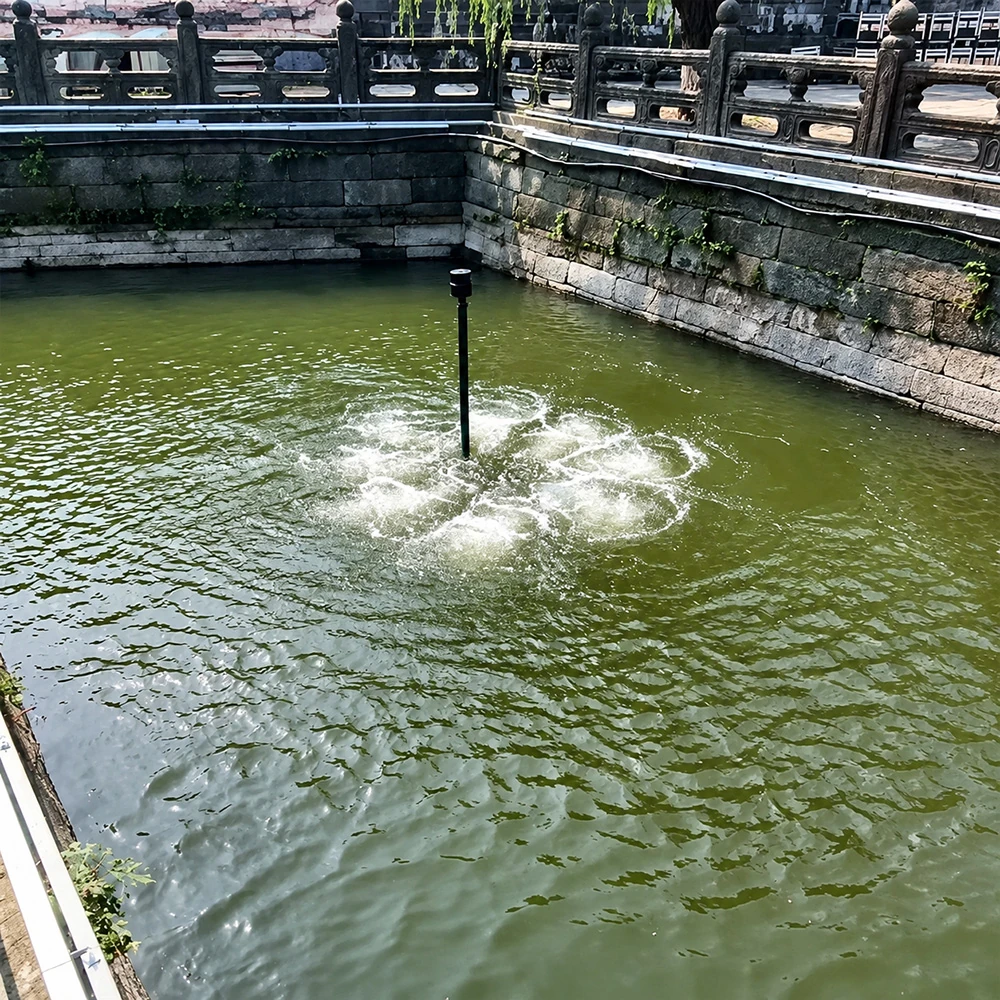
The machine operates completely submerged in water. It relies on the high-speed impeller to generate negative pressure and autonomously draw in air. The air and sewage are strongly sheared in the mixing chamber of the equipment to form micron-sized fine bubbles, which simultaneously complete the dual functions of oxygen supply and water propulsion, thus preventing sludge settling at the source.
Self-Priming Aeration Ensures Uniform Oxygen Distribution
The equipment automatically draws air from the water surface during operation. The bubbles are fine and diffuse widely, resulting in uniform dissolved oxygen distribution throughout the pool. This ensures the continuous activity of aerobic microorganisms and keeps the sludge suspended without settling.
Strong Water Circulation Prevents Dead Zones and Sludge Settling
The high-speed rotation of the impeller generates a continuous directional water flow, which drives the circulation of water throughout the pool. The flow velocity throughout the pool is kept stable at over 0.3 m/s, completely preventing the accumulation of sludge at the bottom and corners of the pool.
Integrated Design Simplifies Installation and Maintenance
No external fans or air ducts are required, reducing investment in civil engineering and piping materials. It operates underwater without noise, occupies a smaller area, and can be used with small sewage treatment plants and integrated equipment.
Comparison of Wastewater Treatment Challenges and Solutions
| Common operational challenges | Equipment solutions | Actual usage effect |
| Large areas of sludge accumulated at the bottom of the pool | Continuous flow to maintain the suspended velocity of the water body | Significantly reduced dredging frequency; no thick sediment at the bottom of the pool. |
| Oxygen deficiency and uneven dissolved oxygen at the edges and corners of the pool | Microbubbles diffuse throughout the entire area, providing balanced oxygen supply. | Stable microbial activity and improved biochemical treatment efficiency |
| Split-type fan pipes are prone to blockage and air leakage. | Self-priming integrated structure, no external air duct required. | The number of potential failure points has been significantly reduced, and the maintenance workload has been halved. |
| The aeration system has high energy consumption. | High air-water mixing efficiency, no pipeline air pressure loss | Under the same processing scale, the energy saving effect is significant. |
How to Select the Right Submersible Centrifugal Aerator for Wastewater Projects
Match Aerator Power with Tank Volume and Oxygen Requirements
Key selection criteria: effective tank volume, designed treatment capacity, COD concentration, and required dissolved oxygen level. Power ranges from 0.75kW to 22kW, with variations in air intake and thrust depending on the model. Smaller units are suitable for small integrated wastewater treatment systems, while higher-power models are suitable for large municipal oxidation ditches.
Choose Suitable Materials Based on Wastewater Conditions
For regular domestic sewage: the entire unit is made of cast iron/carbon steel with anti-corrosion material, offering high cost performance; For chemical, printing and dyeing, and salt-containing corrosive wastewater: the entire unit uses 304/316L stainless steel for flow parts, resisting acid and alkali corrosion; For wastewater with high sediment content: the impeller is coated with a wear-resistant coating, extending its service life.
Select the Right Installation Method for Operation and Maintenance Needs
There are two main installation methods: rail-coupled hoisting type and fixed bracket floor-mounted type. The rail type can be lifted and inspected while the water is still on, without the need to empty the entire pool of sewage, making it suitable for sewage treatment plants that can operate continuously without interruption. The fixed bracket type is suitable for small closed biological treatment tanks and integrated sewage treatment equipment.
Key Advantages of Kairun Submersible Centrifugal Aerators
Based on years of experience in water treatment fluid equipment R&D, Kairun submersible centrifugal aerators have optimized their structure for harsh wastewater conditions, resulting in comprehensive upgrades in durability and energy efficiency.
Optimized Centrifugal Impeller Improves Air-Water Mixing Efficiency
The specially designed centrifugal impeller has a large air intake capacity due to the rotating negative pressure, and sufficient gas-liquid shearing, resulting in oxygen transfer efficiency far exceeding that of traditional aeration equipment; the impeller is wear-resistant and corrosion-resistant, and is not prone to entanglement of fibers, sludge and debris.
IP68 Submersible Motor Ensures Reliable Underwater Operation
Oil-filled Class F insulated submersible motor with built-in overheat and overload protection; double-end silicon carbide mechanical seal for double waterproof protection; maximum diving depth of 20 meters; 24-hour continuous operation without leakage.
Easy Maintenance with Guide Rail Installation
The entire machine is shipped as a single unit, requiring only a fixed bracket/guide rail and cable connection on-site to start production; the guide rail coupled model does not require emptying the tank for maintenance, and a single person can complete the hoisting and maintenance, greatly reducing downtime losses.
Case Study: Municipal Oxidation Ditch Aeration System Renovation
The original aeration system of a municipal wastewater treatment plant in East China has long suffered from problems such as sludge settling, uneven dissolved oxygen, and high electricity costs. The corners of the biological treatment tank are severely silted up, requiring monthly shutdowns for sludge removal.
Project Challenges Before Equipment Upgrade
The original split-type blower aeration system had air leakage in the pipeline, resulting in insufficient dissolved oxygen in the distant tank, multiple dead corners in the tank, large amounts of sludge accumulation, unstable COD removal rate, and persistently high annual electricity costs.
Renovation Plan with Kairun Submersible Centrifugal Aerators
The original blowers, ducts, and aeration discs were removed, and eight 11kW Kairun submersible centrifugal aerators were installed and evenly arranged tangentially along the oxidation ditch wall to construct a full-area circulation aeration system.
Key Benefits of Using Submersible Centrifugal Aerators
Lower Energy Consumption and Operating Costs
With no duct pressure loss and high air-water mixing efficiency, it saves more than 20% of electricity compared with traditional blower aeration equipment for the same processing capacity, resulting in considerable savings in electricity costs over the years.
Simplified Maintenance with Fewer Failure Points
The integrated design eliminates the need for external piping, significantly reducing blockages and leaks; the durable seals and motor components also reduce the frequency of annual maintenance.
Reduced Civil Engineering and Installation Costs
By eliminating the need for supporting facilities such as fan rooms, pre-buried air ducts, and pipe supports, the civil engineering investment for new sewage treatment projects is significantly reduced.
Reliable Performance for Long-Term Operation
With a standard operating condition design service life of 15 years, its corrosion-resistant and wear-resistant structure is suitable for various scenarios such as domestic sewage, industrial wastewater, black and odorous river treatment, and aquatic oxygenation.
Frequently Asked Questions
Q1: Can a submersible centrifugal aerator operate continuously for 24 hours?
A: Yes. The entire machine is equipped with a submersible motor that provides overheat and overload protection, has IP68 underwater protection, and is designed to support continuous operation around the clock. It only requires simple periodic maintenance of lubricating oil and seals.
Q2: What causes excessive vibration during equipment operation?
A: Common causes: impeller entanglement with cloth strips or fibrous sludge; loose mounting brackets; uneven impeller wear; installation depth too low, causing contact with the tank bottom. These issues can be resolved by cleaning debris, tightening the brackets, and inspecting the impeller.
Q3: Is this aerator suitable for small-scale integrated sewage treatment equipment?
A: Fully compatible. The low-power 0.75kW/1.5kW models are compact in size and come with a fixed bracket, allowing direct installation into the integrated biochemical chamber without the need for an additional fan.
Conclusion
Sludge settling, uneven dissolved oxygen, and excessive energy consumption are long-standing problems plaguing wastewater treatment plants. Submersible centrifugal aerators, relying on a self-priming aeration and integrated all-area flow design, simultaneously fulfill the two core requirements of oxygenation and agitation circulation, eliminating sludge deposition dead zones at the source. For various scenarios including municipal sewage, industrial wastewater, river ecological restoration, and aquaculture, Kairun can customize matching power, materials, and installation solutions based on tank volume, water quality, and treatment capacity. Leveraging mature hydraulic models, reliable sealed motors, and convenient operation and maintenance structures, Kairun provides long-lasting and energy-efficient underwater aeration solutions for global water environment governance projects.