A tubular casing pump carries liquid through a tube-shaped casing after it passes an impeller and diffuser. The casing name on its own won’t tell you whether it uses axial flow or mixed flow hydraulics, or whether it fits your site.
That’s an easy distinction to miss when comparing quotes. One supplier leads with the casing layout, another names the impeller, and a third describes the installation. All three descriptions can be accurate, yet none establishes the duty point: the required flow rate and head at which the unit must operate.
As a buyer, you need to link those terms to the job at your site. A river intake, drainage station, and cooling circuit can share a tubular layout while needing different pump choices. Water levels, liquid quality, available space, and maintenance access also shape the decision.
This guide explains the terminology, separates the hydraulic choices, and shows what to request before comparing prices. You’ll see how a tubular casing pump works, where the layout applies, and which documents let you compare proposals on the same basis.
Key Takeaways
- Tubular casing describes the flow passage and assembly; axial flow and mixed flow describe the hydraulics.
- Select against the full flow and head range, including low-water and high-tailwater conditions.
- Minimum submergence and net positive suction head are separate checks; passing one doesn’t establish the other.
- Pull-out construction is an optional arrangement that needs a defined removal route and lifting space.
What Is a Tubular Casing Pump?
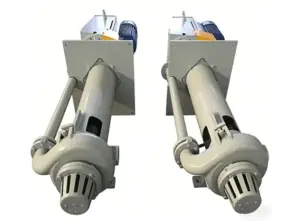
A tubular casing pump is a rotodynamic pump that directs liquid through an impeller, a diffuser, and a tube-shaped casing. Vertical arrangements are common, with the column pipe surrounding the drive shaft. The pump can use an axial flow or mixed flow impeller, to suit the required duty.
The impeller adds energy to the liquid. The diffuser guides liquid from the impeller toward the column pipe. Liquid then travels through the column toward a discharge elbow and outlet nozzle. In a shaft-driven vertical arrangement, bearings support the shaft between the hydraulic end and the drive.
The KSB tubular casing pump definition describes these components and layout choices. It also stresses the need to study inlet conditions. A cylindrical casing doesn’t, by itself, prevent air entry, swirl, or cavitation.
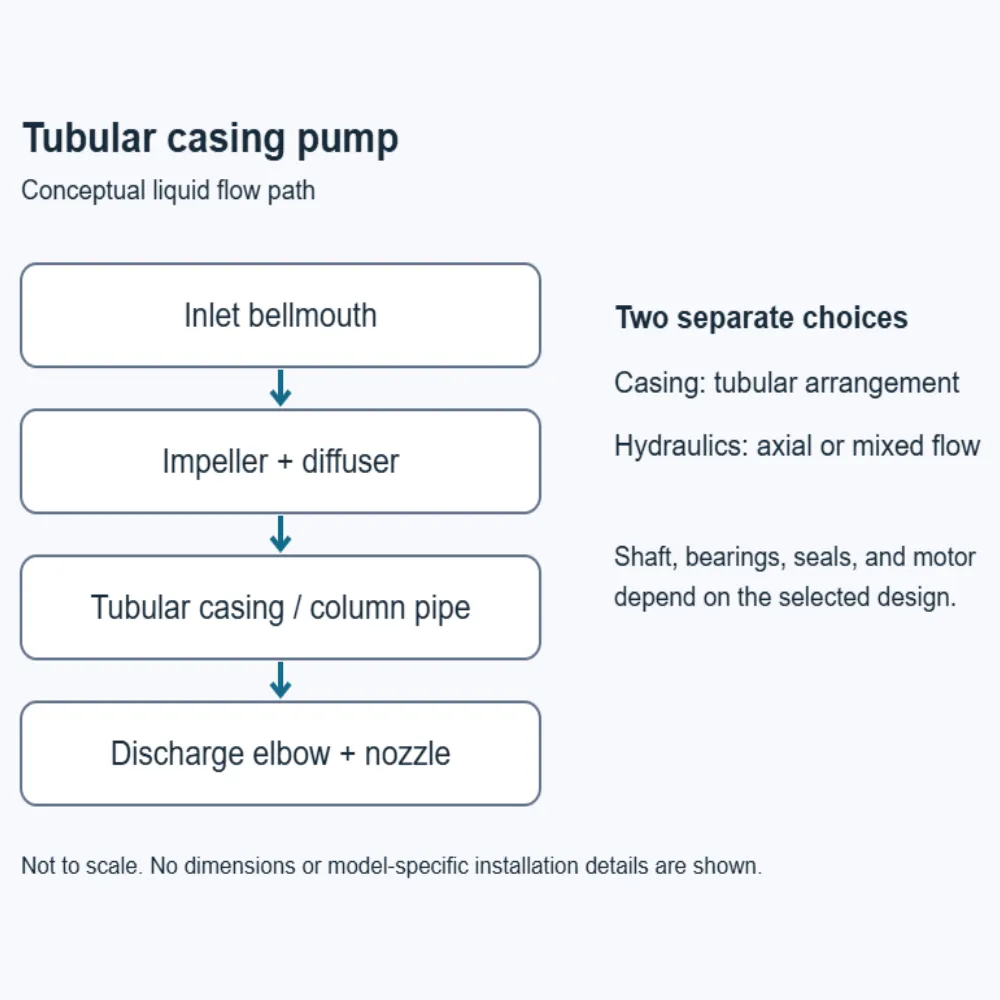
Conceptual flow sequence, not a construction drawing. Shaft supports, seals, dimensions, and motor arrangements depend on the selected design.
If your application calls for large-volume, low-lift water transfer, explore the axial flow pump range as a starting point. Confirm the operating conditions before choosing a particular layout.
Tubular Casing Pump Types: Axial and Mixed Flow
A tubular casing pump combines the casing layout with an impeller design. Keep those choices separate when reading a specification. The same column width or outer shape doesn’t prove the pumps will do the same job.
How the hydraulic choices differ
Both choices are rotodynamic pumps: a spinning impeller adds energy to the liquid. Here is what each label tells you:
- Axial flow: Liquid moves mainly along the shaft as it passes through the impeller. Start here for large flows at low head, then check the curve.
- Mixed flow: Liquid leaves the impeller both along and outward from the shaft. Consider it where the required head and flow suit the design.
- Both types: The label sets no firm head limit. It also can’t prove which choice uses less power at your duty point.
| Selection question | Axial flow candidate | Mixed flow candidate |
|---|---|---|
| What does the label describe? | Impeller flow direction | Impeller flow direction |
| What service should you investigate? | Large-volume transfer at low lift | Water transfer where the head requirement suits a mixed flow selection |
| What establishes suitability? | Selected curve and operating limits | Selected curve and operating limits |
| What remains separate? | Casing, drive, intake, and removal arrangement | Casing, drive, intake, and removal arrangement |
For a concrete example, KSB describes its SEZ as a vertical tubular casing pump with an open mixed flow impeller. This is a KSB product example, not a specification for Kairun equipment.
Compare proposals at the same duty
Fictional training scenario: Alex compares two proposals
Alex prepares an irrigation inquiry with an assumed duty point of 4,000 m³/h at 6 m head. One proposal names an axial flow design; the other offers mixed flow hydraulics. Instead of rejecting either label, Alex requests the curves, efficiency, shaft power, and operating limits at the same duty point.
The result is a comparison sheet with matching inputs, rather than a choice based on product names. These figures are teaching assumptions, not a pump recommendation or customer case.
Use the same checks to replace a tubular casing pump:
- Keep the required flow and head, including the range of water levels at the site.
- Check how the new unit fits, with a drawing that shows the shaft, base, and outlet.
- Compare shafts, bearings, flanges, and bases by their details; similar names don’t prove that parts will fit.
Applications and Installation Choices
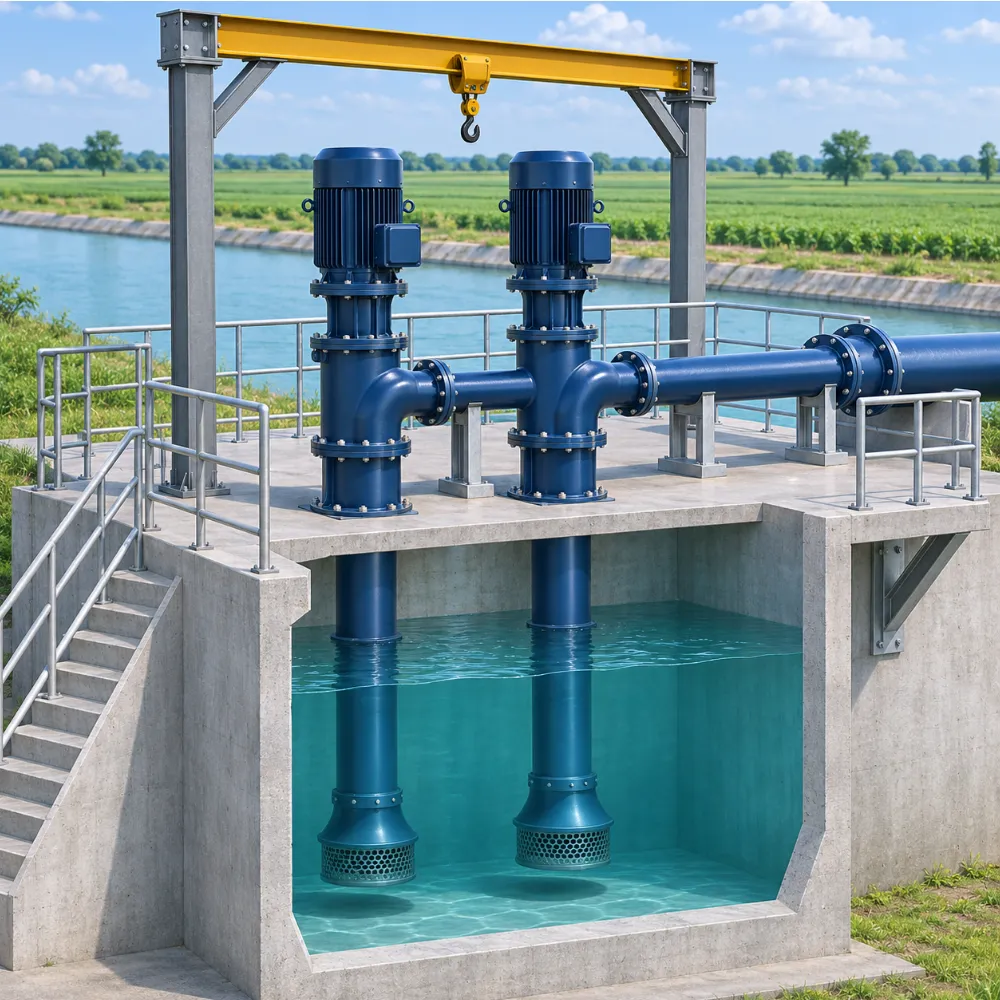
Tubular casing pump layouts appear in cooling-water service, low-lift pumping stations, and seawater desalination systems. Irrigation and drainage are also relevant services for suitable designs. Start with the job, then check the liquid and the full flow and head range.
Wet well or dry installation
Use this layout checklist when you review a tubular casing pump drawing. Each choice changes what the site must provide.
| Layout choice | What to check before civil work |
|---|---|
| Wet well | The inlet bellmouth stays below the liquid surface with the required depth and floor clearance. |
| Dry installation | The pump joins an intake elbow or chamber cover through a sealed suction connection; the inlet layout needs review. |
| Outlet above the floor | Check pipe supports, space around the elbow, and access to the drive. |
| Outlet below the floor | Check the buried or lower-level pipe route, joints, access, and how loads reach the structure. |
| Motor support | Show whether the motor loads the discharge elbow or has its own support. |
A deeper column needs a longer shaft and the right bearing supports. Ask for a drawing that shows the full build. A short catalog entry can’t set the bearing spacing or shaft alignment limits for a deeper unit.
Pull-out access and design variants
A pull-out tubular casing pump can allow removal of the internal hydraulic assembly while leaving major casing connections in place. Availability and removal scope depend on the design. The motor, support, or discharge cover can still need removal, with enough lifting height to clear the assembly.
How to Select a Tubular Casing Pump
Start tubular casing pump selection with an operating range. A catalog maximum can’t show where the pump will run in your system. The same applies whether you are evaluating axial flow or mixed flow hydraulics.
Establish flow, head, and power requirements
List each required flow rate with its inlet and outlet water levels. Total dynamic head includes elevation, pressure, and velocity differences between the selected system boundaries, plus losses. Open reservoirs simplify that calculation, but screen, pipe, bend, and valve losses still matter.
For each case, find where the pump curve meets the system curve. Check more than the normal duty point:
- Normal water levels: Confirm flow, head, and efficiency where the pump will spend most of its running hours.
- Low inlet level: Check the extra lift, available NPSH, and inlet depth at the same time.
- High outlet level: Check the rise in backpressure and the resulting flow on the pump curve.
- Pumps running together: Use the combined pump and system curves; a second pump does not simply double the flow.
- Range limits: Keep every case within the limits agreed by the pump maker.
The Hydraulic Institute pump-curve guide explains head, efficiency, power, and suction curves. The best efficiency point (BEP) is where pump efficiency peaks for a defined configuration. Use it as a guide, then check the limits for your model.
Ask how much power the pump needs across its full allowed range, as well as at the duty point. Check power demand near low flow as well as near peak flow, using the actual curve. The maker must approve how to start the unit and set the valves for that design.
Check the intake at the lowest operating level
Minimum submergence is the required liquid depth above a specified pump reference. It helps control intake problems such as air-drawing vortices. Net positive suction head (NPSH) concerns the liquid’s pressure margin above vapor pressure at the pump inlet.
A tubular casing pump needs both checks. Use the same datum levels and the limits for your model. Check that available NPSH exceeds required NPSH by a margin agreed for the job. Separately review submergence, clearances, inlet approach, and potential swirl with the responsible designer.
Our guide to cavitation and suction checks explains the background. Its submersible-pump context doesn’t establish dimensions or limits for your vertical shaft-driven assembly.
Fictional training scenario: Sam checks a low-water condition
Sam reviews an assumed drainage layout where the inlet level can fall 0.8 m below the normal level. The nominal duty point still looks acceptable on the initial sheet, but the intake review is incomplete. Sam pauses the proposed stop-level setting and requests the reference elevation, submergence requirement, and low-level suction calculation.
The outcome is a documented design question before controls are set. The 0.8 m change is an illustration, not an allowable operating limit.
Match the liquid and the hydraulic end
A tubular casing pump for clean water isn’t automatically a sewage or slurry pump. Give the supplier a liquid profile with these checks:
| Liquid detail | What the supplier needs to confirm |
|---|---|
| Grit and hard particles | Wear limits and suitable parts for the measured solids content |
| Fibers and larger solids | Free passage and any need for screening before the pump |
| Salt and chemicals | Material grades for the casing, shaft, impeller, seals, and fasteners |
| Hot or cold liquid | The allowed range for the pump, bearings, seals, and motor arrangement |
If an axial flow and a mixed flow offer both meet the nominal duty point, compare their allowed ranges and materials. Neither name proves the pump will resist corrosion or clogging. State what the supplier must show.
Compare Quotations and Plan Maintenance

A useful tubular casing pump quotation defines what is supplied, how it performs, and how it fits. Price and flow alone leave gaps. One offer might include a motor or site work that another leaves out.
Put the same information in each inquiry
Use one request for quotation (RFQ) sheet for every candidate:
- Hydraulic duty: Normal duty point, minimum and maximum operating cases, and system curves.
- Liquid: Temperature range, chemistry, solids, grit, and any material restrictions.
- Intake: Water-level elevations, approach geometry, screen losses, and available drawings.
- Configuration: Axial flow or mixed flow selection, speed, impeller setting where applicable, and assembly identification.
- Mechanical interfaces: Column length, discharge elevation, flange details, foundation loads, and lifting route.
- Drive and controls: Supply voltage and frequency, starting method, protection, and speed-control requirements.
- Evidence and scope: Curves, material schedule, assembly drawing, inspection plan, acceptance criteria, exclusions, and spare parts.
Ask the supplier to flag each change from the requested duty point. For an existing tubular casing pump, include measured operating data and the current assembly drawing where available. A model name won’t tell the supplier about an old impeller change or a new pipe run.
Considering a vertical tubular well arrangement? Review Kairun Pump’s vertical tubular well axial flow pump as a related option. The product page places the motor above the water and the pump body below it. Request an agreed curve and build drawing for your duty; the page doesn’t establish every tubular casing variant.
Define how the equipment will be serviced
Ask for the chosen unit’s installation, operation, and maintenance instructions. Use it to close these points before you order a tubular casing pump:
- Heaviest lift: Confirm the mass to lift at each stage and the load the lifting gear can handle.
- Clear height: Check that the shaft and pump parts can clear the floor, roof, and crane hook.
- Removal route: Mark the order of work, access to bolts, and the path through doors or roof openings.
- Pull-out scope: Confirm which parts lift out and which pipe joints, if any, stay in place.
- Bearing care: Get the exact list of parts that need oil, grease, or flush water, plus wear and replacement limits.
- Model evidence: A competitor’s ceramic-bearing entry doesn’t prove that all designs have maintenance-free bearings.
For a proposal using a submersible motor arrangement, the submersible pump VFD guide covers questions about variable frequency drive (VFD) control. A shaft-driven unit needs its own approved motor, shaft, bearing, and speed limits. Reducing speed doesn’t automatically keep either design inside its permitted range.
Record flow, head, power or current, water level, and vibration at the accepted duty point during site checks. Keep these readings as a starting record for later checks. When readings change, make a short record before choosing a repair:
- Note which flow, level, power, or vibration reading changed and when it began.
- Check the intake screen and the site water levels against the accepted start-up record.
- Compare the measured duty point with the approved curve and limits for that build.
- Use the unit’s service guide to plan further checks; don’t assume the impeller needs replacing.
Frequently Asked Questions
What is the purpose of a pump casing?
The casing contains and directs the pumped liquid. In a tubular casing pump, the flow passes through the diffuser into a tube-shaped passage. The whole unit also needs supports, joints, and seals that suit its pressure and loads.
Is a tubular casing pump always an axial flow pump?
No. A tubular casing pump can use axial flow or mixed flow hydraulics. The casing label describes the arrangement, while the impeller label describes flow through the hydraulic end. Check the exact design on the supplier’s drawing and curve.
What type of pump is best for irrigation?
It depends on flow, head, source water, and how you deliver that water. Axial flow can suit low-lift canal transfer; mixed flow can be another candidate where its curve matches the requirement. A pressurized network needs a separate hydraulic assessment. Compare energy and operating limits at the actual duty point.
Does pull-out construction mean no dismantling is needed?
No. Pull-out construction defines a removal arrangement, not an absence of work. The motor, support, coupling, or cover can still need dismantling. Ask which assembly lifts out, what it weighs, and whether suction and discharge connections remain undisturbed on that particular design.
Specify the Pump Around Its Operating Conditions
A useful tubular casing pump specification links the flow and head to the way the unit fits on site. Define both before choosing a model. Each supplier then works from the same duty point, so you can see where their offers differ.
Keep three decisions separate: the axial flow or mixed flow hydraulic selection, the casing and drive arrangement, and the station interfaces. Then bring them together on an agreed curve and build drawing. Check normal flow, changing water levels, the intake, power needs, and the path to lift out parts.
Before issuing an order, close the gaps in scope. State who supplies the intake design, controls, lifting gear, and test records. Agree how to judge the tests and attach the chosen build to the quote. Then track changes against that record.
To discuss a tubular casing pump for your site, send your project conditions, with flow, head, liquid details, water levels, and site drawings. Use those inputs to ask for a pump choice backed by a curve and drawing for your site.