Axial flow pump specifications should define a paired flow rate and head, speed, power basis, liquid conditions, and site limits. The largest flow figure on a brochure cannot tell you whether a pump suits your station.
Comparing supplier sheets gets hard when one lists a series range, another lists a single duty point, and a third quotes motor power. Give each supplier the same design conditions. Ask for the same records to support their offer.
This guide explains how to read axial flow pump specifications without mixing those categories. You’ll find a field-by-field checklist, two attributed catalog examples, and a worked power calculation. It also shows which details belong on the pump curve and which need a site drawing or motor data sheet.
The examples separate published model data from assumed teaching values. They don’t prove which model fits your site. Use the checks to prepare a clearer inquiry, find missing information early, and compare offers at your required flow rate and head.
Key Takeaways
- Compare flow and head at one duty point, with the same speed and blade setting.
- A power value in kW needs a label: hydraulic power, shaft input, motor output rating, or electrical input.
- Minimum submergence and Net Positive Suction Head (NPSH) need separate checks.
- Kairun’s listed model points are catalog references; project curves and intake drawings still need confirmation.
Axial Flow Pump Specifications: Fields to Check
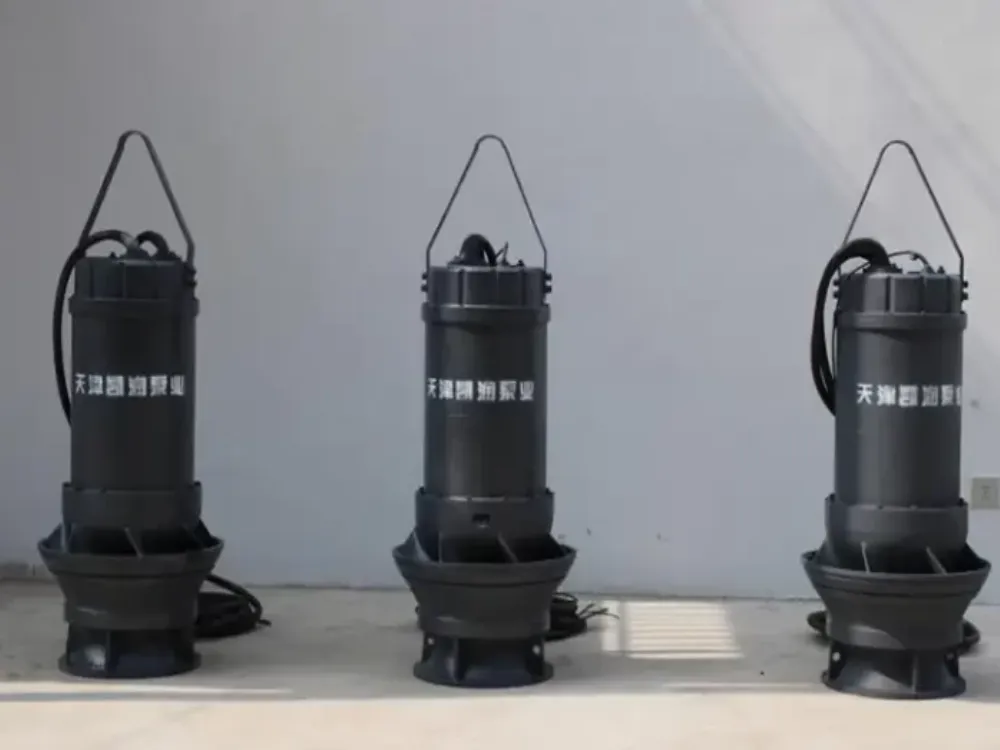
Start with the design conditions. Axial flow pump specifications become useful when each value has a unit and a stated condition. Keep a source for each value.
| Field | Unit or format | What to confirm |
|---|---|---|
| Required flow rate | m³/h or L/s | Per pump or whole station; normal and peak demand |
| Total dynamic head | m of pumped liquid | Head at the stated flow and water levels |
| Speed and blade setting | r/min and degrees | Exact configuration covered by the pump curve |
| Impeller diameter | mm | Actual hydraulic size, separate from discharge size |
| Power | kW | Definition of the value and maximum absorbed load |
| Efficiency | % | Pump-only or complete system; stated duty point |
| Inlet conditions | NPSH, liquid level, drawing | Cavitation margin, vortex control, and clearances |
| Liquid and materials | Composition and grades | Temperature, solids, corrosion, and wear basis |
| Electrical supply | V, Hz, phases | Motor power rating, controls, and supply compatibility |
| Acceptance records | Standard, grade, scope | Agreed test method and documented results |
Next step: Put your required flow rate, head, and liquid details beside this table before comparing suppliers. Mark every blank field as a question for the quotation.
Keep requirements separate from offered values
Use two columns in your project datasheet: what you need and what the supplier offers. A third column can cite the pump curve, drawing, or test record.
For example, a requested duty point of 3,600 m³/h at 5 m is a project requirement. It doesn’t become an offered performance point because a product family covers 3,600 m³/h somewhere in its range.
Also record the document date and revision. If axial flow pump specifications change during quotation, the revised values should remain tied to the same model and configuration. That keeps an old drawing from being checked against a new pump choice.
Match Flow Rate and Head on the Pump Curve
A pump curve shows how one pump setup performs across a range of flow. The operating point occurs where that curve meets the system curve. The system curve shows the head your site needs at different rates of flow.
For transfer between large open reservoirs, head includes the water-level difference and line losses. Other systems can also include pressure and velocity terms. Don’t use pipe length or vertical lift alone as total head.
The Hydraulic Institute’s pump curve tutorial explains the separate head, efficiency, power, and NPSH curves. Together, they provide more information than one headline duty point.
Check the operating range
Ask the supplier to plot low, normal, and high water-level cases. Your axial flow pump specifications should list those cases and the flow rate at each. Ask for the allowed operating range.
The best efficiency point is where pump efficiency peaks for the stated pump setup. It is a useful reference, but the supplier must define the allowed range around it. Avoid applying one percentage band to every axial pump design.
Fictional scenario: Alex checks a brochure claim. Alex needs 3,600 m³/h at 5 m for a drainage proposal. A brochure lists 5,000 m³/h, so they add the series to their list. When Alex asks for a pump curve, the offer still lacks a marked duty point.
They return the sheet for clarification and add the required head beside the flow. The result is a clearer request, not proof that the pump meets the duty.
Keep the setup behind the numbers
Record speed, impeller diameter, and blade angle with the curve. Changing one can change head, flow, and absorbed power. Axial flow pump specifications for one setting do not prove the same values at another.
If several pumps share a discharge system, ask for the combined pump curve and a check of the whole system. Adding a second unit doesn’t automatically double station flow. For axial flow pump specifications, the relevant comparison is the flow delivered at the required system head.
Read Motor Power and Efficiency Correctly
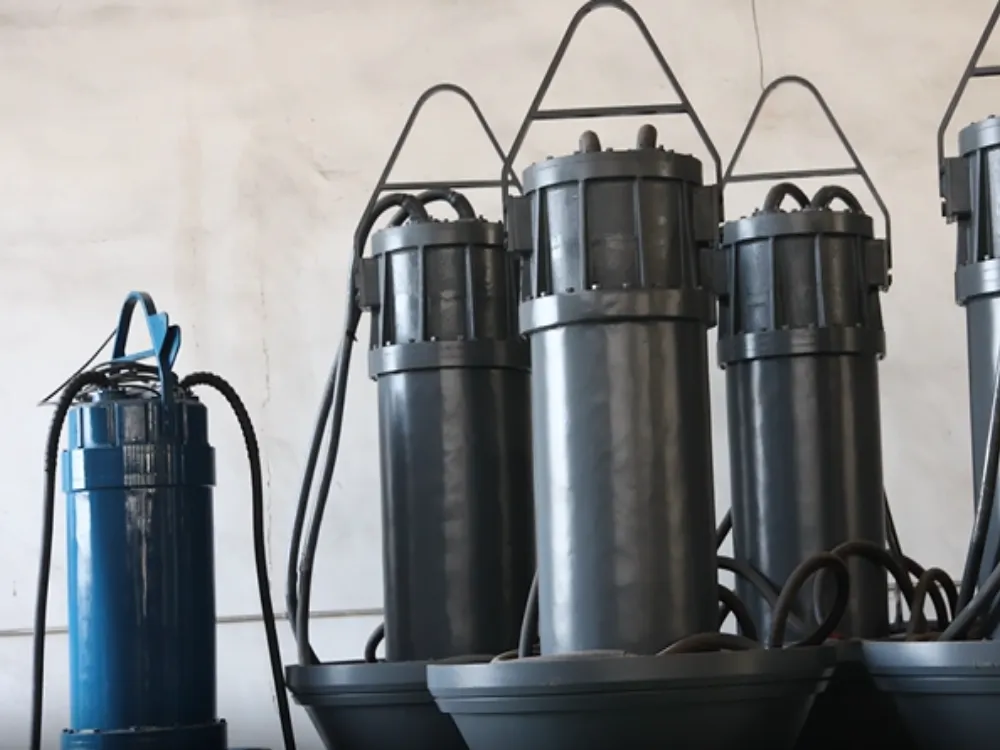
Power is easy to misread. Axial flow pump specifications may show hydraulic power, pump shaft input, rated motor output, or electrical input. All use kW. They mean different things.
Hydraulic power is the rate of useful energy added to the liquid. Shaft power includes the pump’s losses. Electrical input also includes motor losses and, where fitted, losses in the drive. Motor power on a nameplate normally describes rated mechanical output; check how the supplier defines it.
Work through a clear example
Assume clean water at 1,000 kg/m³, a flow rate of 3,600 m³/h, and 5 m head. Convert flow to 1 m³/s. Using gravity of 9.81 m/s²:
- Hydraulic power = density × gravity × flow × head ÷ 1,000 = 49.05 kW.
- At an assumed pump efficiency of 80%, shaft input = 49.05 ÷ 0.80 = 61.31 kW.
- At an assumed motor efficiency of 94%, electrical input = 61.31 ÷ 0.94 = 65.23 kW, excluding drive losses.
These assumed values are for teaching, not Kairun model data. They show why motor power cannot be read directly from hydraulic power. A final motor power rating requires the maximum shaft load over the agreed operating range, plus the design needs for that project.
When checking axial flow pump specifications, ask which losses the stated efficiency includes. A pump-only value does not show the whole station’s energy use. Compare efficiency at the required duty point and account for hours spent at other conditions.
Check loading away from the design point
Prime Pump’s axial-flow guidance notes that power consumption can increase as flow decreases. Don’t assume throttling an axial pump reduces its motor load.
Ask for the absorbed-power curve across the approved range. Include the planned start and stop sequence. Then check motor power against that load. Complete axial flow pump specifications should connect the hydraulic duty, motor power basis, and control method, rather than leave three unrelated numbers on the sheet.
Check Intake, Materials, and Electrical Details
A model can match the required flow rate and still need changes to its intake layout. Axial flow pump specifications should therefore include site conditions alongside hydraulic values.
Separate cavitation and vortex checks
Net Positive Suction Head available, or NPSHA, is the inlet head available above the liquid’s vapor-pressure head. Compare it with the pump’s required NPSH, or NPSHR, with a margin suited to the duty and supplier’s guidance.
Minimum submergence addresses a different concern: keeping the inlet far enough below the liquid surface to limit air-core vortices. The Hydraulic Institute’s submergence guidance explains this distinction and notes that NPSH requirements can call for greater depth.
Ask for the lowest allowed water level and its reference point. Check inlet gaps and intake shape. Use the related pump cavitation checks to prepare questions about temperature, inlet losses, and site conditions.
Specify the liquid before choosing materials
Record temperature, chemical composition, solids size and concentration, and abrasive content. Use these details to choose the pump and its parts. Axial flow pump specifications that say only “stainless steel” leave the alloy grade and component coverage unclear.
Request a component material list for the impeller, casing, shaft, seals, and fasteners. Check that each part suits the actual liquid. Don’t infer a solids-passage limit from the discharge diameter or assume every axial design suits fibrous waste.
Match the drive to the supply
Check voltage, frequency, phases, motor power, starting current, protection, and cable requirements. A different supply frequency can change speed and the pump curve. Motor power alone cannot prove that the motor suits the supply.
For variable-speed operation, request approved speed limits and checks of cooling, stable flow, and trip settings. The submersible pump VFD checks explain the site questions to resolve. Record the accepted speed range in the axial flow pump specifications, with the corresponding duty point checks.
Compare Axial Flow Pump Specifications by Model
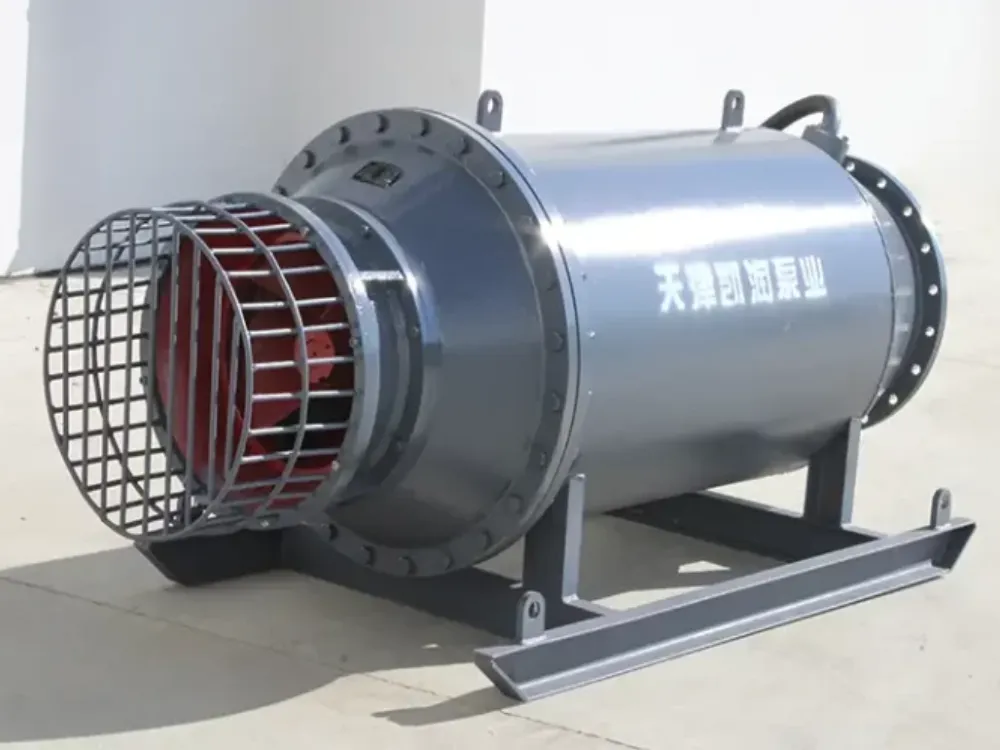
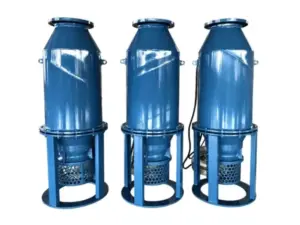
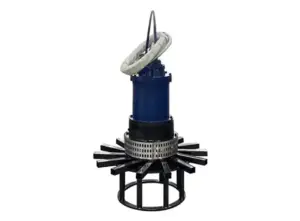
The following figures come from Kairun’s submersible axial flow catalog, checked November 13, 2026. Each row is one model point listed by Kairun.
| Model | Blade angle | Flow rate | Head | Listed power | Speed | Impeller outer diameter |
|---|---|---|---|---|---|---|
350QZ-100D | 0° | 802.9 m³/h | 1.92 m | 11 kW | 1,450 r/min | 300 mm |
1600QZ-75 | 0° | 32,616.3 m³/h | 7.09 m | 900 kW | 295 r/min | 1,480 mm |
The source labels its power column simply “Power (KW).” It doesn’t say this column gives measured electrical input. Request the power basis and motor power schedule before using either value in an energy or electrical calculation.
These axial flow pump specifications illustrate paired catalog values. They aren’t a combined range, an independent test, or a guarantee for your site.
Turn catalog data into project data
Request a current pump curve with your duty point marked and the supplied setup named. If a catalog’s text and table differ, ask the supplier for a corrected sheet.
Fictional scenario: Priya reviews an intake drawing. Priya compares two offers for an irrigation station. Both list the requested flow and head, but one leaves out the water-level reference point.
They keep that field open in the comparison and ask for an intake drawing before they approve the layout. The result is a clear drawing requirement. No assumed installation depth or promised performance fills the gap in the axial flow pump specifications.
Next step: If your duty needs a different head range, include the mixed flow pump range in the technical discussion. Compare proposed curves at the same duty point before choosing a hydraulic type.
Questions Buyers Ask About Axial Pump Datasheets
What flow rate and head should I specify?
Specify the required flow rate together with total head for each operating case. Axial flow pump specifications need both values at the same duty point. State whether flow applies to one unit or the station, and identify standby units separately.
Can I select a pump from motor power alone?
No. Motor power doesn’t establish flow, head, efficiency, or intake suitability. Start with the required duty point, check it on the pump curve, and then verify the load. Two offers with the same motor power can suit different flow and head needs.
Does an axial pump have one standard maximum head?
No universal maximum applies to every design and application. Use the selected model’s stated range. Axial flow pump specifications for drainage equipment should not inherit limits from a specialized process-circulation pump, or from another brand’s series.
Does deeper water remove the need for an NPSH check?
No. Greater depth can contribute to available inlet head, but liquid temperature, inlet losses, and the pump’s NPSHR still matter. Check both the cavitation margin and intake layout. A water-level note alone doesn’t complete either assessment.
What should accompany a one-row catalog specification?
Request the pump curve, power definitions, liquid basis, installation drawing, electrical schedule, and agreed acceptance requirements. With these records, you can check the axial flow pump specifications in an offer. Keep unanswered items open. A blank field does not mean the offer meets your needs.
Turn the Datasheet Into a Complete RFQ
A request for quotation (RFQ) should let suppliers answer the same questions. Attach your axial flow pump specifications with these supporting details:
- Normal and peak flow rate, head cases, water levels, and operating hours.
- Liquid temperature, composition, solids, and required material grades.
- Intake layout, installation dimensions, lifting access, and available supply.
- Required pump curve, absorbed-power curve, motor power data, and permitted operating range.
- Proposed test standard, acceptance grade, reporting scope, and documents needed for review.
Keep a column for differences in the reply sheet. Ask each supplier to list what is left out and what still needs an answer. This gives each tick in the sheet a clear meaning.
Your next step
Begin with a paired duty point, then follow the evidence through the curve, drive, and intake arrangement. The practical value of axial flow pump specifications comes from that connection. A large flow figure, a high efficiency claim, or a motor rating cannot replace it.
Before you approve an offer, check that the model, speed, and blade setting agree across the quote and drawings. Confirm what each power value means. Resolve the minimum operating water level and liquid requirements, and agree how performance will be checked.
Keep catalog references separate from project guarantees. If the supplier has not confirmed a material grade, power basis, or site dimension, leave it open in the review. A clear question now is better than an unchecked guess when you place the order.
Next step: Send your pump duty and site details to Kairun Pump with your axial flow pump specifications. Include the required flow and head, liquid conditions, intake layout, and electrical supply so the inquiry starts with a clear scope.