What Is a Vertical Axial Flow Pump?
Vertical axial flow pumps, introduced by Kairun Pumps, are primarily used for flood control, drainage, high-flow water intake, and irrigation. Their main features include high flow rate, low head, and a self-priming capability, eliminating the need for priming or foot valves, as the impeller is always submerged in the liquid. Vertical axial flow pumps are mainly divided into two structural types: long-shaft dry vertical axial flow pumps and submersible vertical axial flow pumps.
Core Structural Features of Vertical Axial Flow Pump
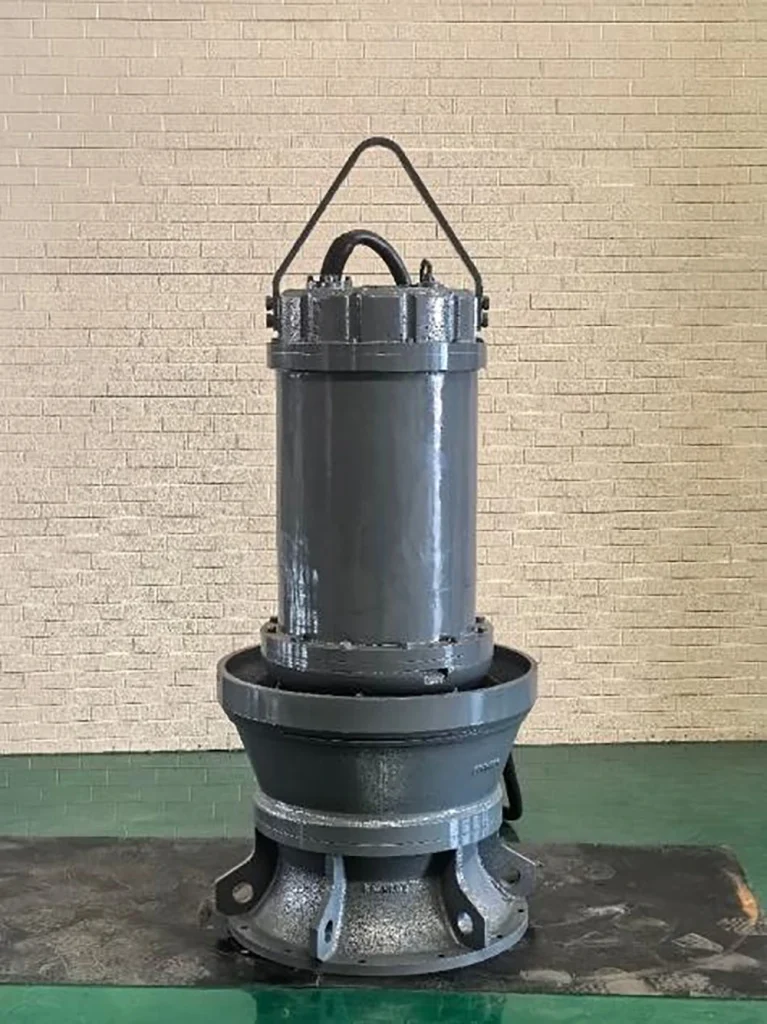
Vertical axial flow pumps typically have their pump shaft mounted vertically, with the motor positioned above the pump body, transmitting power to the impeller via a long shaft. The impeller is submerged, drawing water directly from below. This long-shaft drive structure is used, and large units often feature multi-stage bearing support. To maintain stability, guide bearings and thrust bearings are installed, along with shaft seals or mechanical seals.
Traditionally, we use long-shaft dry pumps, where the motor is located above the water and power is transmitted through the shaft. These pumps typically feature multi-stage guide bearings. The motor and couplings, along with other key components, are above water for easy maintenance. The units are relatively tall, making them suitable for deep wells and deep-water pumping stations.
Another type of submersible vertical pump has both the motor and pump body located underwater. The submersible motor directly drives the impeller, typically eliminating the need for a long shaft drive. The motor housing and cable inlet must be sealed. It is usually hoisted as a whole or installed underwater, resulting in a lower unit size and greater space savings.
Main Installation Methods of Vertical Axial Flow Pump
Multiple installation methods are available to adapt to different pump station structures, water level environments, and site requirements:
1. Ground Installation: Suitable for vertical, fixed ground installation in standard pump pits and conventional pump stations.
2. Suspended Installation: Utilizes a suspended hoisting method, saving space in the civil engineering foundation.
3. Inclined/Skirt Installation: Suitable for water intake and drainage scenarios in rivers, slopes, and riverbanks.
4. Horizontal Installation: Suitable for sites with height restrictions and special pump station layouts.
5. Floating Easy Installation: Connected via rubber hoses, it floats with the water level; convenient for hoisting and relocation in waters with large water level fluctuations.
Typical Application Scenarios
Vertical axial flow pumps are commonly used in flood control and drainage, agricultural irrigation, large-flow river water intake, factory circulating water, and sewage treatment projects.
Conclusion
Vertical axial flow pumps are a typical type of high-flow, low-head water pump, characterized by mature structure and high operating efficiency, and are widely used.
When selecting a pump, first determine the pump type and impeller parameters based on the flow rate, head, and water level.The different types are then determined based on the medium, whether the pumping station has sufficient space, whether long-term operation is required, and ease of maintenance.Finally, the installation method will be determined based on the site conditions.