Key Takeaways
- Air intake volume and oxygen transfer capacity are different indicators. A higher air intake rate does not automatically mean better oxygenation.
- Actual oxygen demand depends on organic matter removal, ammonia oxidation, treatment efficiency, and operating hours.
- Tank depth, wastewater characteristics, and equipment layout affect aeration performance.
- Equipment selection should be based on oxygen transfer capacity under actual operating conditions, not only on clean-water test data.
Which Performance Parameters Should You Check First?
When evaluating a submersible centrifugal pump, buyers should distinguish between air supply and oxygen transfer performance. These indicators describe different functions and should not be used interchangeably.
Air Intake Volume and Oxygenation Capacity
Air intake volume indicates how much air enters the equipment per hour, usually expressed in m³/h. It helps estimate air supply capacity, but it does not show how much oxygen actually dissolves in wastewater.
Oxygenation capacity measures the amount of oxygen transferred into water per unit of time, usually in kg O₂/h. This value is more directly related to the oxygen demand of a treatment process. However, the test conditions must also be checked. Clean-water test results cannot be treated as actual oxygen transfer performance in wastewater.
Standard and Actual Oxygen Transfer Rates
Standard oxygen transfer rate (SOTR) is measured under standard clean-water conditions. Actual oxygen transfer rate (AOTR) reflects operating conditions such as wastewater characteristics, temperature, dissolved oxygen concentration, and water depth. The correction from SOTR to AOTR is essential when estimating field performance.
Energy Efficiency and Supplier Data
Standard aeration efficiency (SAE) indicates the amount of oxygen transferred per unit of energy consumed, commonly expressed as kg O₂/kWh. It helps compare energy performance, but only when the test conditions are consistent.
Before comparing equipment, request the air intake rate, oxygen transfer capacity, motor power, operating depth, and test conditions. If a supplier provides only an air intake figure, ask for oxygen transfer data as well.
How Do Water Depth and Wastewater Conditions Affect Selection?
Water depth affects both air intake and oxygen transfer. As installation depth changes, the equipment must overcome different hydrostatic pressure. This can change air intake volume and operating performance.
Installation Depth and Water-Level Changes
Check the actual water depth at the installation point rather than relying only on the tank’s total height. If the water level fluctuates, evaluate both normal and maximum operating depths. The selected equipment must remain within its permitted submergence range.
Wastewater Characteristics and Tank Layout
Wastewater characteristics also influence oxygen transfer. High concentrations of suspended solids, grease, or fibrous material may cause deposits or blockages around air passages and mixing components. Some industrial wastewater may also contain substances that affect material compatibility.
For a submersible pump for aerator tank, the selection review should include tank dimensions, water depth, wastewater composition, required dissolved oxygen, and the position of existing equipment. Check whether columns, pipes, screens, or tank corners create poorly mixed areas.
A practical layout review should identify the effective mixing area and compare it with the tank floor area. If one unit cannot cover the tank evenly, multiple units or a revised installation layout may be necessary. Increasing motor power alone will not necessarily solve dead-zone problems.
How Do You Calculate the Required Aeration Capacity?
Equipment capacity should match the treatment process’s oxygen demand. A preliminary estimate can begin with the organic matter removal load and the ammonia oxidation requirement.
Estimate Organic Matter and Nitrification Demand
Assume a wastewater flow of 1,000 m³/day. The influent BOD₅ is 200 mg/L, and the target effluent BOD₅ is 50 mg/L.
The BOD₅ removal load is:
1,000 × (200 − 50) ÷ 1,000 = 150 kg BOD₅/day.
If the process also oxidizes 20 kg of ammonia nitrogen per day, the theoretical oxygen requirement for nitrification is approximately:
20 × 4.57 = 91.4 kg O₂/day.
Convert Oxygen Demand into Equipment Capacity
Assume the preliminary total oxygen demand is 240 kg O₂/day and the aeration system operates for 20 hours per day. The required average oxygen transfer rate is:
240 ÷ 20 = 12 kg O₂/h.
If the corrected oxygen transfer capacity of one unit is 8 kg O₂/h under actual operating conditions, the calculation is:
12 ÷ 8 = 1.5.
At least two operating units are therefore required to meet this preliminary demand. Standby capacity should be considered separately according to the plant’s reliability requirements.
This example is only a preliminary estimate. A final design must also consider biomass synthesis, endogenous respiration, treatment process configuration, peak loads, dissolved oxygen targets, and operating margins. Theoretical oxygen demand should not be the sole basis for equipment procurement.
When comparing a wastewater treatment pump, use the corrected oxygen transfer capacity under site conditions. Do not divide the required oxygen demand by a clean-water SOTR value without applying the appropriate correction factors.
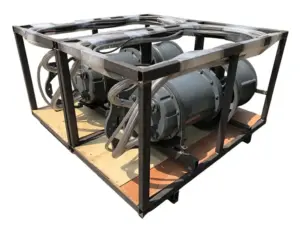
KR Pumps QXB Series Submersible Centrifugal Aerator: Specifications and Applications
After assessing the treatment process and tank conditions, buyers can compare the following specifications to check motor power, installation depth, air intake, and oxygenation capacity.
Main Specifications
| Model | Power | Speed | Max. Submergence | Air Intake | Oxygenation Capacity |
| QXB0.75 | 0.75 kW | 2900 rpm | 2.5 m | 10 m³/h | 0.37–2.5 kg O₂/h |
| QXB1.5 | 1.5 kW | 2900 rpm | 2.5 m | 22 m³/h | 0.75–5.0 kg O₂/h |
| QXB2.2 | 2.2 kW | 1470 rpm | 3 m | 35 m³/h | 1.1–7.5 kg O₂/h |
| QXB3 | 3 kW | 1470 rpm | 3.5 m | 50 m³/h | 1.5–10 kg O₂/h |
| QXB4 | 4 kW | 1470 rpm | 4 m | 75 m³/h | 2–14 kg O₂/h |
| QXB5.5 | 5.5 kW | 1470 rpm | 5 m | 85 m³/h | 2.8–19 kg O₂/h |
| QXB7.5 | 7.5 kW | 1470 rpm | 6 m | 100 m³/h | 3.7–24 kg O₂/h |
| QXB11 | 11 kW | 1470 rpm | 6 m | 160 m³/h | 5.5–30 kg O₂/h |
| QXB15 | 15 kW | 1470 rpm | 6 m | 200 m³/h | 7.5–40 kg O₂/h |
| QXB18.5 | 18.5 kW | 1470 rpm | 6 m | 260 m³/h | 9.2–50 kg O₂/h |
| QXB22 | 22 kW | 1470 rpm | 6 m | 320 m³/h | 11–60 kg O₂/h |
The series is listed with a 380 V, 50 Hz power supply and Class F insulation. Oxygenation capacity varies with submergence depth, so the listed range should not be interpreted as guaranteed output at every installation depth. Buyers should request performance data for their intended operating conditions.
Integrated Air Intake and Water Mixing
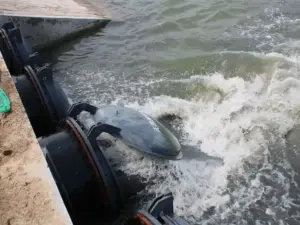
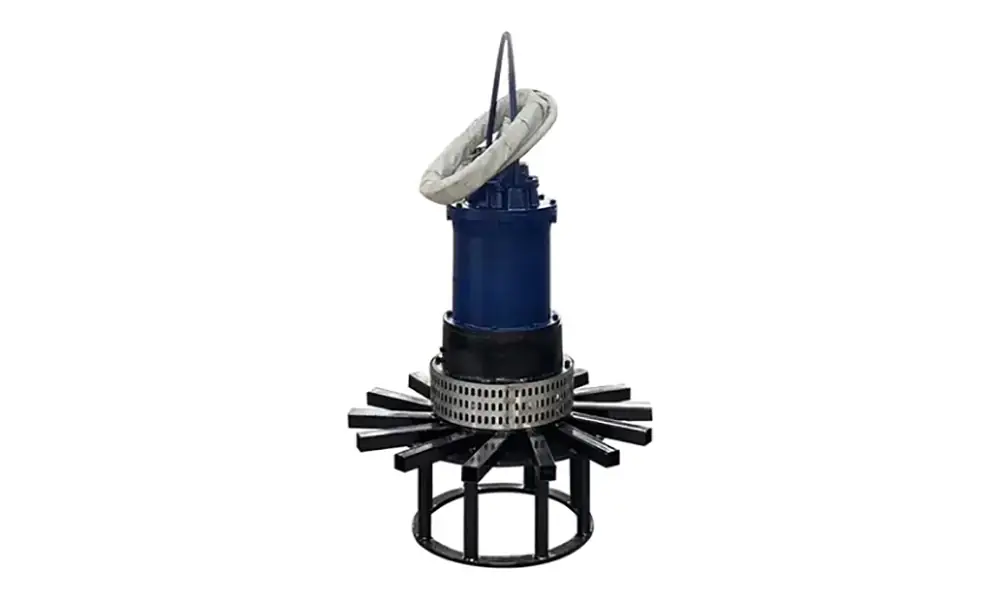
The equipment uses a submersible motor to drive a centrifugal aeration impeller. The impeller creates negative pressure at the air intake, drawing air through the intake pipe. Air and water are then mixed and sheared by the rotating impeller.
This arrangement combines air intake and water movement in one unit. It can reduce the need for separate air-distribution piping in suitable tank layouts. During technical review, buyers should confirm the air intake pipe arrangement and whether the installation position allows unobstructed air entry.
Bottom Mixing and Tank Circulation
A bottom mixing plate helps disperse the air-water mixture and promote circulation near the tank floor. This is useful in tanks where suspended solids may settle or uneven mixing can create poorly treated areas.
The installation layout should account for tank shape, equipment spacing, and obstructions. The number and position of units should be checked against the tank’s actual dimensions rather than selected solely by motor power.
Model Range and Selection
The QXB range covers motor power from 0.75 to 22 kW, with listed maximum submergence depths from 2.5 to 6 m. Buyers can use these ranges to shortlist models, but should not select a unit based only on rated power or air intake.
For example, if the calculated site requirement is 12 kg O₂/h, the relevant model’s oxygenation capacity must be checked at the intended submergence depth. If its corrected capacity is below the required value, a larger model or multiple units may be needed.
Applications and Routine Maintenance
The series is intended for wastewater aeration, including municipal treatment tanks and industrial effluent applications. It is also listed for aquaculture pond oxygenation and river or lake restoration.
Routine checks should include motor current, abnormal noise, vibration, mechanical seal condition, and impeller wear. If air intake decreases, inspect the intake pipe for blockage, leakage, or improper positioning. The unit should not be operated dry.
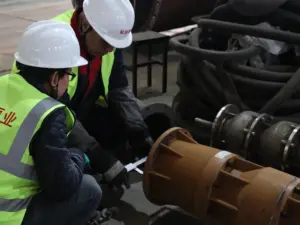
Before ordering, confirm the required voltage and frequency, cable length, installation accessories, lifting arrangement, and maintenance access. These details affect installation and long-term operation.
Frequently Asked Questions
What is the difference between air intake and oxygenation capacity?
Air intake measures the volume of air entering the equipment per hour. Oxygenation capacity measures the oxygen transferred into water per hour. The two values are related but are not interchangeable.
Does greater installation depth always improve oxygen transfer?
No. Greater depth can increase the contact time between bubbles and water, but it also increases hydrostatic pressure and may affect air intake. The actual result depends on equipment performance and operating conditions.
How should I select a QXB model for an existing aeration tank?
Calculate the required oxygen transfer rate first. Then check the model’s oxygenation capacity at the actual submergence depth, tank dimensions, and wastewater conditions. Confirm the installation layout and operating hours before finalizing the model.
Can one unit cover an entire aeration tank?
Not necessarily. Coverage depends on tank geometry, water depth, mixing range, and obstructions. Large or irregular tanks may require multiple units to reduce poorly mixed areas.
What should be checked if air intake becomes weaker during operation?
Inspect the air intake pipe for blockage, leakage, or incorrect positioning. Also check the impeller, motor operating condition, and whether the installation depth has changed.
Conclusion
Reliable aeration selection starts with the treatment process’s oxygen demand, not motor power alone. Buyers should calculate the required oxygen transfer rate, correct performance data for actual wastewater conditions, and check whether the equipment can cover the tank evenly.
A submersible aerator should be evaluated according to its actual oxygen transfer capacity, installation conditions, and operating requirements rather than air intake alone.
If you are sourcing a submersible aerator pump for a wastewater treatment or industrial effluent project, please provide your required treatment flow rate, tank dimensions, water-level range, wastewater characteristics, oxygen demand, operating hours, installation position, and available power supply. Contact Kairun to discuss a suitable aeration configuration and request a quotation tailored to your project’s operating requirements.