Key Points
The energy consumption of a submersible sewage pump depends not only on motor power. It is also affected by pump selection, the actual operating point, system head, pipeline resistance, and operating time. Reducing energy costs therefore requires more than comparing purchase prices. A proper assessment should consider energy use, clogging risks, maintenance needs, and downtime costs. The key is to match the pump to the actual pumping system and wastewater characteristics.
What Causes Low Efficiency in Submersible Sewage Pumps?
1. Pump Selection Does Not Match the Actual Operating Conditions
The efficiency of a submersible sewage pump depends largely on how well its performance matches the actual operating conditions. The pump must operate at the required flow rate and head. However, if selection is based only on maximum flow, maximum head, or motor power, the pump may run outside its suitable operating range for long periods. For example, if the pump’s rated capacity is much higher than the system’s actual demand, it may operate inefficiently and fail to deliver its expected hydraulic performance.
2. Excessive Pipeline Resistance Reduces Effective Transport Efficiency.
The efficiency of a submersible sewage pump is also affected by the entire pipeline system. Wastewater must overcome resistance from pipes, elbows, valves, and other components as it moves from the pump outlet to the discharge point. An unsuitable pipe diameter, an overly long pipeline, or high local resistance can increase hydraulic losses during transport.
3. Incompatibility Between Wastewater Characteristics and Impeller Design
The properties of wastewater directly affect the operating performance of a sewage pump. Sewage may contain solids, long fibers, or other debris. If the impeller flow channel is not designed to handle them, it may become restricted or blocked. As this happens, wastewater flow can decrease, preventing the pump from using its full conveying capacity.
What Causes Excessively High Energy Costs for Submersible Sewage Pumps?
1. Extended Operating Periods will Drive Up Energy Costs.
Energy costs depend not only on a pump’s power rating but also on how long it runs. A pump that operates continuously or for long periods each day can accumulate high electricity consumption over its service life, even when its operating power matches system requirements. This is especially relevant in municipal wastewater treatment plants, industrial wastewater systems, and other applications that require long daily operating hours.
2. Energy Costs Represent Only a Portion of the Operating Costs.
Power consumption is a major long-term expense, but it is not the only one. In sewage applications, the properties of the wastewater also affect maintenance needs. Solids, fibers, and other debris can clog the impeller or increase the pump’s operating load. If the pump must be stopped frequently for cleaning or maintenance, labor, spare parts, and service costs can increase.
3. The Long-Term Value of a Submersible Sewage Pump Depends on Its Lifecycle Cost.
For submersible sewage pumps intended for long-term use, the purchase price is only one part of the total cost. A better evaluation should include electricity consumption, routine maintenance, repairs, and downtime after installation. The pump’s economic value should therefore be assessed over its full lifecycle rather than by its initial price alone.
For example, two pumps may have different purchase prices. A lower-cost pump may consume more energy under actual operating conditions or require more frequent cleaning and maintenance. Over time, those costs can reduce its initial price advantage. By contrast, a pump that matches the operating conditions well and provides stable wastewater conveyance with straightforward maintenance may offer better lifecycle value even if its purchase price is higher.
Practical Steps to Improve the Efficiency of Submersible Sewage Pumps and Reduce Energy Costs
1. Perform Pump Selection Based on Actual Operating Conditions.
To reduce energy costs, first make sure the pump’s performance matches the actual operating conditions. Determine the normal flow rate, peak flow rate, and actual head. Then identify the operating point by considering pipeline resistance. If pump capacity is much higher than required, the pump may run for long periods at low load or under less efficient conditions. If capacity is too low, it may fail to meet peak drainage demand. Proper selection is therefore about matching flow, head, and operating requirements rather than simply choosing a higher motor power.
2. Reduce Unnecessary Energy Losses in Piping Systems
After selecting the pump, inspect the entire conveyance system. Pump energy use is closely related to system resistance. Long pipelines, unsuitable pipe diameters, and excessive elbows or valves can increase flow resistance. The pump must then provide more head to achieve the required flow rate. If these losses continue, energy consumption can remain high even when the pump itself is operating normally. Pump selection should therefore be considered together with pipeline design so that less energy is lost to resistance.
3. Select an Appropriate Impeller Configuration Based on the Characteristics of the Wastewater.
Reducing energy costs is not only about hydraulic efficiency. The pump must also pass wastewater through the housing reliably. Solids, fibers, and other debris can cause clogging when the impeller flow channel is not suitable for the fluid. A clogged pump may need to stop for cleaning, which disrupts drainage and adds labor and downtime costs. For wastewater with high levels of solids or fibers, select an impeller with suitable flow capacity for the actual fluid. Reducing clogging helps the pump operate more steadily and limits the costs caused by frequent cleaning and shutdowns.
4. Continuously Monitor Actual Energy Consumption Using Operational Data.
After installation, use operating data to check whether the pump is still working within a suitable range. Record the flow rate, head, operating power, running time, and any blockage or maintenance events. Compare these figures with the original design conditions. If the actual flow rate stays below or above the design value, or if blockages and maintenance become more frequent, reassess the pump selection, pipeline resistance, and impeller configuration. Continuous monitoring can reveal operating problems early, before they lead to excessive energy use or equipment failure.
5. Evaluate Energy Consumption Alongside Maintenance Costs
Improving the economic performance of a submersible sewage pump requires more than tracking power consumption. Operating time, maintenance frequency, and unplanned downtime also affect total cost. A pump that operates reliably, reduces clogging, and needs less manual cleaning or repair may deliver better long-term value even if its purchase price is not the lowest. During procurement and operation, consider energy use, reliability, maintenance needs, and downtime risk together.
Why Choosing the WQ Series from Kairun Pump Helps Reduce both Operating and Lifecycle Costs?
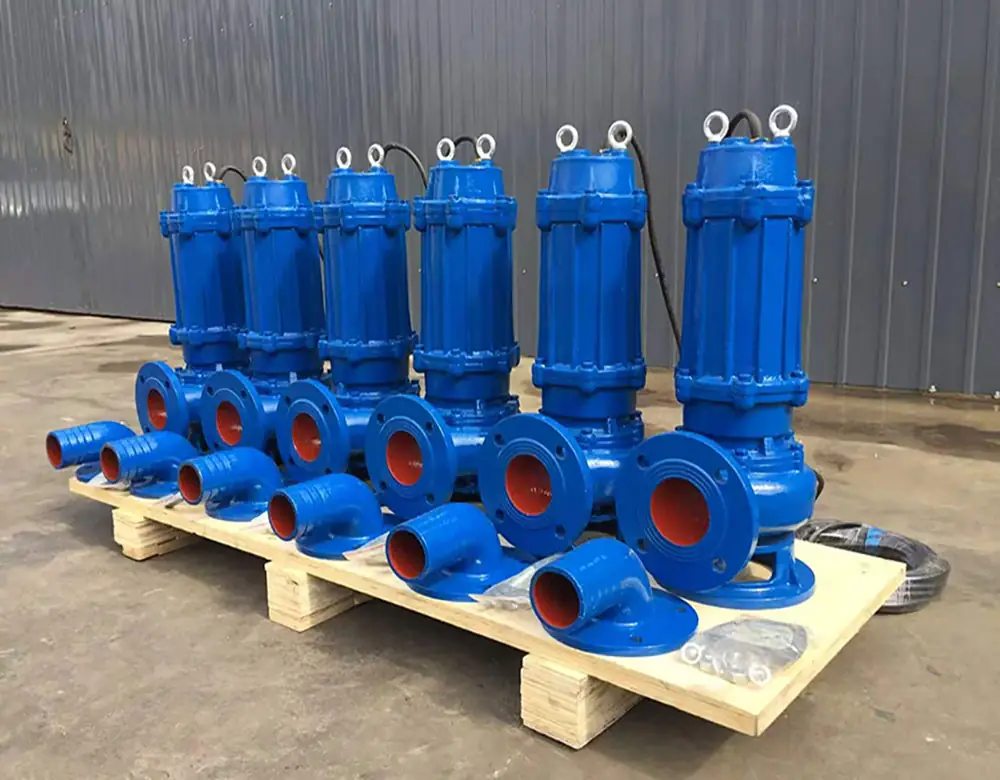
The Kairun Pump WQ series includes submersible sewage pumps for municipal wastewater, building drainage, and industrial wastewater conveyance. The series is designed for wastewater that contains solids, fibers, or debris and for applications that require long-term submersible operation. It covers a wide range of flow rates, heads, and motor powers. Material options include cast iron and stainless steel, allowing purchasers to select a suitable model for the required flow, wastewater characteristics, and installation conditions. Features such as large-diameter impellers, double-ended mechanical seals, IP68 protection, and an optional automatic coupling system address practical needs such as wastewater passage, motor sealing, and maintenance. The key technical specifications are as follows:
| technical parameter | WQseries |
| Flow Rate | 5–4,500 m³/h |
| Standard flow range | 5–2,000 m³/h |
| Head | 4–78 m |
| Motor Power | 0.75–315 kW |
| Standard Voltage/Frequency | 380V/660V, three-phase, 50Hz |
| Optional frequency/voltage | 60 Hz and other voltages |
| medium temperature | ≤40°C (Standard) |
| insulation grade | Class F Standard / Class H Optional |
| levels of protection | IP68 |
| Standard cable length | 8 m – customizable |
| Pump body material | HT250 cast iron / 304 or 316 stainless steel |
| Maximum Solid Particle Size | Approximately 80% of the discharge port diameter; depends on the specific configuration. |
1. Offers a Variety of Impeller Options Tailored to Different Wastewater Characteristics.
A suitable impeller is important for reliable sewage pump operation. The Kairun Pump WQ series offers different impeller options for different applications. Its official product information lists a cutting impeller for fibers and debris. For wastewater with a high content of fibrous material or other contaminants, this option can help reduce the risk of debris interfering with normal drainage.
The WQ series also covers a wide range of flow rates and heads. According to the published product information, the listed models have flow rates of 10–4,000 m³/h and heads of 6–57 m. Maximum motor power reaches 315 kW. This range allows purchasers to choose a configuration for specific operating conditions rather than rely on one specification for every project. The actual flow rate and head should still match the pumping system. Excess capacity can increase energy use, while insufficient capacity may fail to meet drainage demand.
2. Double-Ended Mechanical Seal Helps Protect the Motor.
A submersible sewage pump operates in the conveyed medium, so preventing wastewater from reaching the motor and other internal components is essential for reliable operation. The Kairun Pump WQ series uses a double-ended mechanical seal between the pump and motor. Oil-resistant O-rings help secure the sealing points. The official product information also states that the main mechanical seal uses hard alloy and silicon carbide.
3. The Automatic Coupling Device Makes Maintenance more Convenient.
Maintenance convenience is another part of lifecycle cost. Submersible sewage pumps are often installed in collection wells or other locations that require long-term submerged operation. If maintenance requires personnel to enter the well and remove the pump manually, the work can become more difficult and time-consuming.
The Kairun Pump WQ series can be equipped with an automatic coupling device. According to the manufacturer, the pump can be lifted, detached, and reconnected using a guide rail during maintenance or repair. This avoids the need for engineering personnel to enter the water to disassemble the pump. The arrangement simplifies removal and reinstallation and can reduce maintenance workload.
4. Material Selection Tailored to Different Wastewater Environments
Wastewater composition varies by application. Municipal wastewater, industrial wastewater, construction site drainage, and environmental remediation can present different conditions. A material that works well for conventional municipal wastewater may not be suitable for more corrosive industrial wastewater.
Kairun Pump states that the WQ series can use different stainless steel materials based on the fluid being handled. Standard materials are selected to meet requirements for mechanical strength, wear resistance, and other performance needs. This approach allows the pump to be configured for the actual wastewater instead of using one material scheme for every application.
5. Multiple Configuration Options Facilitate the Appropriate Selection of Equipment under Actual Operating Conditions.
Kairun Pump offers the WQ series in a range of configurations rather than as a single standardized model. The official documentation covers different discharge diameters, flow rates, head ratings, motor powers, rotational speeds, and voltage options. The company also offers customization for voltage and frequency, materials, and paint colors.
6. Why are These Designs Related to Lifecycle Cost?
The value of the WQ series should be assessed through overall operating performance, not only the purchase price. The cutting impeller helps handle fibers and debris. The double-ended mechanical seal helps isolate wastewater from the motor. The automatic coupling system simplifies removal and maintenance. Material options allow the pump to suit different wastewater environments. These features do not prove a specific percentage of energy savings. Without actual project test data, a fixed energy-saving percentage should not be claimed.
Their more direct value is in addressing common long-term cost drivers such as clogging, component failure, maintenance difficulty, and unsuitable material selection. When the pump matches the required flow, head, and wastewater characteristics, these features can support stable operation and help control maintenance and downtime costs over the service life.
FAQ
Q1. Does a Higher Motor Power Always Result in Higher Efficiency for a Submersible Sewage Pump?
No. Motor power indicates the power the equipment can deliver, but it does not determine pump efficiency by itself. Efficiency also depends on flow rate, head, and input power. A pump that matches the actual operating conditions is therefore a better choice than one selected only for higher motor power.
Q2. Can a High-Efficiency Impeller Necessarily Reduce the Energy Costs of a Sewage Pump?
Not necessarily. Sewage typically contains solid particles and fibers; if the impeller passage is too narrow, it may increase the risk of clogging. For sewage applications, it is essential to strike a reasonable balance between hydraulic performance and the ability to handle solid particles. If frequent shutdowns or manual cleaning are required due to clogging, the theoretical efficiency advantage may not translate into a tangible cost-saving benefit in actual operation.
Q3. What Parameters Need to be Provided When Selecting a Submersible Sewage Pump?
The purchaser should provide the actual flow rate, head, wastewater type, maximum solid particle size, fiber content, installation method, submersible depth, voltage, and frequency. For long-term projects, it is also useful to provide the expected operating hours and usage frequency. More complete information helps the manufacturer select a pump that matches the actual operating conditions.
Q4. How to Compare Submersible Sewage Pumps from Different Manufacturers?
Do not compare pumps only by purchase price, motor power, or maximum flow rate. A better approach is to compare performance at the same flow rate and head. Also consider solids-handling capacity, sealing, motor protection, materials, maintenance needs, and long-term operating requirements. This provides a more realistic view of overall cost.
Conclusion
Improving submersible sewage pump efficiency and reducing energy costs is mainly a matter of proper pump and system matching and lifecycle cost management. Pump energy use depends on more than motor power. Flow rate, head, pipeline resistance, operating time, and wastewater characteristics also matter. Simply replacing a pump with a higher or lower power rating will not necessarily solve high energy consumption.
For the WQ series, the large-impeller design, double-ended mechanical seal, IP68 protection, motor protection, and optional automatic coupling system address common challenges in long-term sewage pumping. These include wastewater passage, sealing, equipment protection, and maintenance. These features cannot be converted into a specific energy-saving percentage without project test data. They can, however, support long-term cost management by improving operational stability and simplifying maintenance.
If you are selecting a submersible sewage pump for municipal wastewater, industrial wastewater, or other drainage applications, contact Kairun Pump Company. Provide details such as flow rate, head, wastewater type, maximum solid particle size, installation method, and power supply. Our engineering team can assess the appropriate WQ series configuration based on your operating requirements and provide the relevant technical specifications, performance data, and model recommendations. This can help you meet your pumping needs while managing long-term operating and maintenance costs.