Key Takeaways
- Size the screen for peak incoming flow rather than average daily flow alone.
- Select bar spacing based on the solids to be retained, downstream equipment requirements, and the risk of blockage.
- Distinguish channel approach velocity from velocity through the screen’s net open area.
- Compare head loss under stated flow and screen conditions, including the effects of accumulated screenings.
- Confirm channel dimensions, installation angle, discharge height, maintenance access, and model-specific capacity before ordering.
Introduction
Screening is an important preliminary stage in many wastewater treatment facilities. It removes coarse solids such as rags, plastics, wipes, and other debris before they reach pumps and downstream treatment equipment. If the screen is undersized, peak inflow or accumulated solids may cause the upstream water level to rise. If the openings are unnecessarily small, the screen may retain more material but also create greater resistance to flow and increase cleaning demand.
Selecting the right equipment therefore requires more than matching a nominal channel width. Buyers need to consider the incoming wastewater, design flow, bar spacing, available hydraulic head, channel geometry, and the way screenings will be removed. These factors determine whether a screen can handle the required duty without creating avoidable operating problems.
What Should a Mechanical Bar Screen Handle in Your Wastewater Application?
Before comparing equipment models, identify the solids the screen is expected to retain and the equipment it needs to protect. Municipal wastewater may contain wipes, rags, plastic packaging, paper, and other coarse debris. Industrial wastewater can also carry fibers, hair, production scraps, and process-specific solids. The composition and quantity of these materials influence the required opening size and cleaning arrangement.
The term mechanical bar screen wastewater describes screening equipment used to remove solids from wastewater through a mechanically operated bar-screening mechanism. However, the equipment name alone does not establish its suitability for a particular duty. Buyers should describe the actual wastewater conditions and the consequences of solids passing through the screen.
For example, a screen installed upstream of a pump may need to intercept materials that could wrap around the impeller or obstruct the pump passage. A screen protecting downstream treatment equipment may have different retention requirements. Smaller openings can capture more material, but they may also increase the quantity of screenings collected and the likelihood of blockage when fibrous debris accumulates.
Design flow is another essential input. Average daily flow helps describe normal operation, but it does not show the maximum hydraulic load that the equipment may experience. Buyers should establish the expected peak flow, daily or seasonal variations, and any significant inflow peaks caused by production shifts or rainfall where relevant.
The operating arrangement also matters. If the facility has a standby channel, bypass, or parallel screening unit, its availability and operating procedure should be considered in the design.
How Do Flow Capacity, Bar Spacing and Head Loss Affect Screen Selection?
Once the screening duty is defined, compare the hydraulic requirements with the screen’s opening configuration and operating conditions. These factors are closely connected: changing the opening size affects the available flow area, while retained solids can reduce that area during operation.
Use Peak Flow to Evaluate Hydraulic Capacity
The screen should be assessed against the design flow that it must handle, not just the average flow recorded during normal operation. If the equipment is selected using an average value, it may not provide sufficient capacity during short periods of high inflow.
A simplified example illustrates the relationship between flow and area. If a channel carries 0.30 m³/s through an effective approach area of 1.0 m², the average approach velocity is:
0.30 m³/s ÷ 1.0 m² = 0.30 m/s
The net open area is smaller than the gross screen area because the bars occupy part of the flow path. The actual hydraulic assessment must therefore account for bar thickness, clear spacing, screen geometry, and the relevant operating water level.
When evaluating a supplier’s capacity figure, confirm the flow rate and the conditions under which it applies. A capacity value without a stated opening size, installation arrangement, or hydraulic condition may not be directly comparable with another model.
Match Bar Spacing to Solids Retention Requirements
Bar spacing is the clear distance between adjacent bars. The appropriate spacing depends on the type and size of solids that need to be retained, as well as the requirements of downstream equipment.
Coarser openings may be suitable where the primary objective is to intercept large debris while allowing smaller particles to pass. Finer openings can retain smaller solids, but they may increase resistance to flow and the amount of material accumulated on the screen. Fibers, wipes, and stringy materials deserve particular attention because they can bridge across openings or wrap around moving components.
EPA guidance describes a range of opening sizes for coarse bar screens, but such general ranges should be treated as background information rather than a substitute for project-specific design. The final spacing should be selected in relation to the wastewater characteristics, the equipment being protected, the expected screenings load, and the hydraulic limits of the installation.
A mechanically cleaned bar screen uses a powered mechanism to remove retained material from the screening surface. Buyers should confirm how the cleaning mechanism moves, where the screenings are discharged, and how the unit responds if debris accumulates faster than expected. Mechanical cleaning can support continuous operation, but performance still depends on correct sizing, suitable spacing, and a workable screenings-disposal arrangement.
Compare Head Loss Under Equivalent Conditions
Head loss is the reduction in hydraulic head as water passes through the screen. It can increase as solids accumulate and restrict the available flow area. If the available head is limited, excessive head loss may raise the upstream water level or reduce the hydraulic capacity of the channel.
For a meaningful comparison, request head-loss information at the specified design flow and opening size. Where available, compare both clean-screen conditions and the operating condition used in the supplier’s design assumptions. Confirm how the supplier accounts for accumulated screenings and what water-level difference the installation can tolerate.
A single head-loss figure is not enough if its flow rate and screen condition are unknown. The result should be evaluated alongside the channel’s hydraulic profile, upstream and downstream levels, and the operating range expected at the site. Design guidance for sewage works also emphasizes the need to account for hydraulic conditions throughout preliminary treatment rather than treating the screen as an isolated component.
What Installation Details Should Buyers Verify?
Hydraulic performance alone does not determine whether a screen will fit an existing channel. Channel dimensions, installation angle, discharge height, and maintenance access must also be checked before an order is placed.
Check Channel Width, Depth and Installation Angle
Measure the clear channel width, operating water depth, channel-bottom elevation, and available headroom. The equipment’s overall width and effective screening width are not necessarily the same. Buyers should use the manufacturer’s dimensioned drawing to confirm the actual clearance required for installation and maintenance.
Installation angle affects the equipment’s arrangement within the channel and the vertical space required for the lifting and discharge mechanism. The available channel depth and upstream water level should be checked against the proposed installation drawing. Do not assume that a unit will fit simply because its nominal width is smaller than the channel width.
Also confirm the screenings discharge height and the location of the collection container or conveyor. If screenings cannot fall into the intended collection point, additional handling equipment or structural changes may be needed. Access for removing accumulated debris and replacing wear components should be considered during layout planning, not after installation.
Review Cleaning, Protection and Maintenance Requirements
The control arrangement should match the facility’s operating needs. Buyers can ask whether cleaning is initiated by a timer, a water-level difference, or another control method, and what happens when the screen becomes obstructed. Where the installation requires it, confirm the availability of motor overload protection, emergency stopping, and safe isolation for maintenance.
Ask the supplier to identify routine inspection points and replaceable components, including rake parts, brushes, bearings, and drive components where applicable. The recommended maintenance interval will depend on operating conditions and the solids load. Wastewater with high fiber content or abrasive material may require closer inspection than a relatively low-solids application.
For an automatic bar screen wastewater treatment installation, automation should be assessed as part of the complete operating arrangement rather than as a guarantee of maintenance-free performance. The facility still needs a way to collect and remove screenings, inspect moving parts, and respond to abnormal operating conditions.
Before finalizing the layout, confirm the available power supply, control requirements, maintenance clearances, and the route for transferring screenings to a suitable collection or disposal point.
Why Choose Kairun’s GSHZ Rotary Bar Screen?
Screen width, opening size, installation angle, and discharge height all affect whether a unit will fit an existing channel and perform as required.
| Specification | Published information |
| Device width | 300–1,500 mm |
| Clear spacing options | 2, 3, 5, 10, 15, 20 and 25 mm |
| Installation angle | 60°, 65°, 70°, 75° and 80° |
| Rake-tooth linear speed | Approximately 2 m/min |
| Applicable channel depth | 800–10,000 mm |
| Screenings discharge height | 400–500 mm as a reference; customizable |
| Motor power | Varies by model; published ranges include 0.37–3 kW |
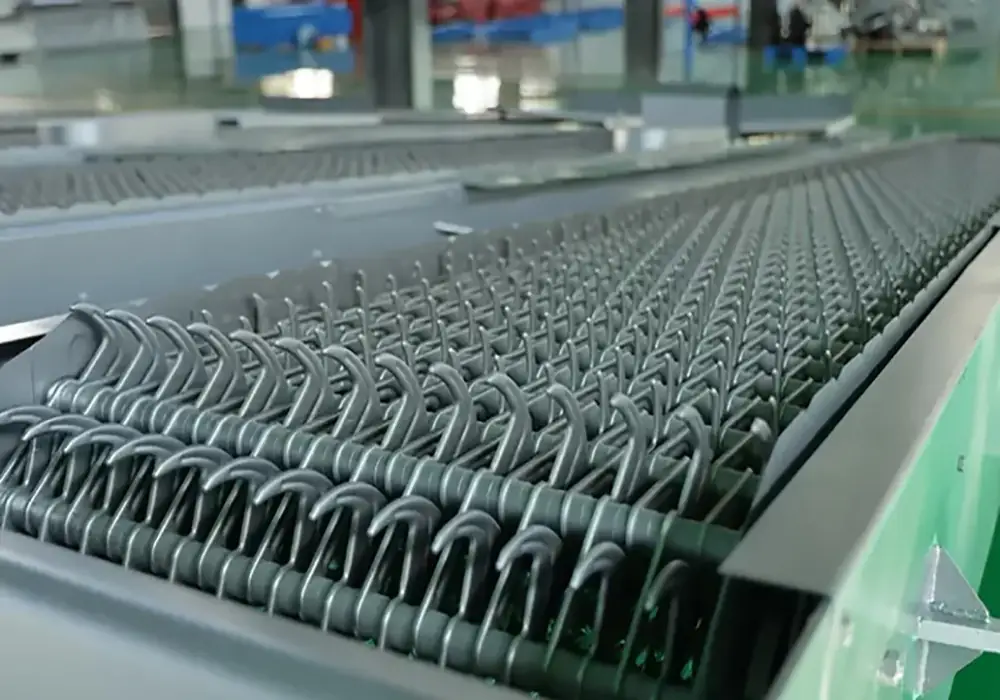
Continuous Raking Lifts Retained Debris Out of the Water
The GSHZ design uses rotating rake teeth to lift retained solids from the water. As the rake assembly moves upward, the collected material is discharged by gravity. This arrangement supports continuous mechanical removal rather than relying solely on periodic manual cleaning.
Actual operating performance depends on the incoming solids load, selected spacing, hydraulic conditions, and the way screenings are handled after discharge. Buyers should confirm that the proposed configuration matches the expected duty.
Rake Movement and Brushes Support Screen Cleaning
The product design uses rake movement and rubber brushes to help clean the screening mechanism. These components support debris removal during operation, but they should not be interpreted as eliminating all blockage risks. Fibrous materials, unusual debris loads, and inadequate maintenance can still affect performance.
For applications with wipes, fibers, or stringy solids, buyers should describe the expected material to Kairun and ask whether the proposed configuration is suitable for those conditions.
Material Options Address Different Wastewater Conditions
The published product information identifies stainless steel, nylon, and ABS for rake-related components, while the frame can use corrosion-treated carbon steel or stainless steel. The appropriate combination depends on wastewater characteristics, corrosion exposure, wear conditions, and the facility’s maintenance requirements.
Buyers should confirm the material configuration available for the selected model rather than assume every material option is included as standard. If the wastewater contains aggressive chemicals or unusual contaminants, provide the relevant operating information before confirming the specification.
Width and Angle Options Help Match Existing Channels
The published dimensions distinguish between overall equipment width and effective gate width. The effective gate width is listed as the device width minus 160 mm, while the overall width is listed as the device width plus 350 mm. These relationships are useful for preliminary checks, but the final installation should be based on the drawing for the selected model.
The available installation angles—60°, 65°, 70°, 75°, and 80°—give buyers several configurations to evaluate against channel depth, operating water level, and discharge clearance. Confirm the dimensions and installation requirements before deciding that a particular unit is suitable for an existing channel.
Applications Include Municipal and Selected Industrial Wastewater
The GSHZ range is presented for applications including municipal wastewater, intake pumping stations, and selected industrial wastewater duties such as textile, dyeing, slaughterhouse, tannery, and paper-related wastewater. Suitability depends on the actual composition and quantity of solids, hydraulic conditions, and the required screening performance.
For a bar screen wastewater treatment plant, the equipment should be assessed as part of the preliminary treatment arrangement. The buyer should confirm design peak flow, selected spacing, installation dimensions, head-loss requirements, and the method for collecting screenings. The published product information should be supplemented with model-specific capacity confirmation before final selection.
Frequently Asked Questions
What does a rotary bar screen remove from wastewater?
A rotary bar screen removes coarse solids such as rags, wipes, plastics, paper, and other debris retained by the selected bar spacing. The actual materials captured depend on the opening size and the characteristics of the incoming wastewater.
How should buyers choose the bar spacing?
Start with the solids that need to be retained and the equipment that needs protection. Then evaluate the effect of the proposed spacing on net open area, expected screenings accumulation, cleaning demand, and head loss at peak flow.
What should be confirmed before ordering the GSHZ model?
Confirm the design and peak flow, required clear spacing, channel width and depth, operating water levels, installation angle, discharge height, wastewater characteristics, power supply, and maintenance access. Request a dimensioned drawing and model-specific capacity confirmation.
Why must a screen be sized for peak flow?
Peak flow can exceed the average flow substantially. A screen sized only for average conditions may create excessive head loss or an upstream level rise when inflow increases, particularly if screenings have already accumulated.
Does automatic cleaning eliminate maintenance?
No. Automatic cleaning reduces the need for manual removal of retained solids, but operators still need to inspect moving parts, remove and dispose of screenings, check wear components, and respond to abnormal blockage or control conditions.
Conclusion
A reliable screening installation needs to do more than intercept debris. It must keep the flow path usable as solids accumulate, discharge screenings where operators can handle them, and allow inspection without unnecessary disruption. Cleaning access and the route from the discharge point to the collection container are easy to overlook during initial planning, yet they affect day-to-day operation.
The GSHZ design combines continuous rake movement with brush-assisted cleaning and offers multiple material and installation options. These features give buyers practical points to assess when matching the equipment to wastewater characteristics and existing channel dimensions.
If you are sourcing a rotary bar screen for a municipal wastewater facility, an intake pumping station, or industrial wastewater containing fibers and debris, prepare your peak flow rate, required bar spacing, channel width and depth, operating water levels, discharge height, wastewater characteristics, and available power supply. Contact Kairun to discuss a suitable GSHZ configuration and request a quotation based on your operating requirements.