If you have ever worked on river dredging, sand mining, or mine tailings disposal, you will be all too familiar with this scene:
A conventional slurry pump sits at the bottom of a pond. Suction is weak, the slurry concentration is low, and before long the sand clogs the pump. So you set up a high‑pressure water cannon beside it, and assign someone full‑time to spray the settled layer to try to fluidise the material. The cannon runs for a while, the pump runs for a while – efficiency is dismal, and labour costs are high. When the sediment is heavily compacted, the water cannon cannot even break it up, so you have to stop the pump and send workers down to dig.
Worse still, the ordinary pump pulls up mostly water, leaving the solids behind. After a whole day’s work, the dredging result is disappointing.
These are the “old‑school” methods that have plagued the dredging and sand extraction industry for years.
What makes them “old‑school”? Three core pain points
Pain point 1 – Dependence on auxiliary equipment
Traditional pump‑based dredging requires multiple pieces of equipment – high‑pressure water cannons, slurry pumps, and so on. More equipment means more hoses, more messy layouts, and higher power consumption. In remote sites without a power supply, none of this equipment can even be used.
Pain point 2 – Clogging is a daily headache
Ordinary slurry pumps are not designed to handle large solids or settled materials. As soon as the slurry gets a little thicker, the inlet chokes; if a particle is slightly oversized, the impeller jams. Shutting down for cleaning and pump disassembly becomes routine.
Pain point 3 – Low concentration, poor efficiency
The slurry drawn up by a standard pump typically has a solid concentration of only 10‑20%. Most of what is pumped is water, while the actual sand and sediment remain behind. The dredging is incomplete, the concentration is too low, and the whole project suffers in both progress and profitability.
A new approach: one pump = mixing + pumping
The submersible slurry pump with agitator is, in essence, a structural upgrade to the traditional slurry pump.
The idea is simple: integrate “mixing” and “pumping” into a single unit, and perform both tasks simultaneously.
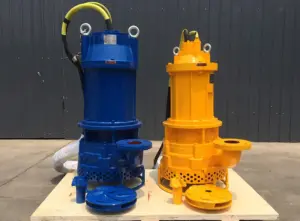
The pump and motor are coaxial and fully submersible in the medium. In addition to the main impeller, an agitator (also called a mixing device or cutter) is mounted at the bottom of the pump. Both the agitator and the main impeller are driven by the same motor shaft, rotating at the same time.
During operation, the agitator spins at high speed, lifting the sediment (sand, sludge, tailings) from the bottom and turning it into a homogeneous turbulent slurry. The main impeller then draws in this high‑concentration slurry, pressurises it, and discharges it. The entire process happens in one continuous flow.
In a nutshell: it creates its own slurry – no need for a helper with a water cannon.
Kairun Pump SS Series: a machine truly designed for “mixing while pumping”
In the field of submersible slurry pumps with agitators, the SS Series from Tianjin Kairun Pump Co., Ltd. is a model worth highlighting.
1. Full coverage for accurate selection
The SS Series offers dozens of models ranging from SS30-30-7.5 to SS2000-35-315, with discharge diameters from 80 mm to 400 mm, flow rates from 23 to 2,400 m³/h, and a maximum head of 64 m. Motor power spans from 7.5 kW to 315 kW across 72 power grades.
What this means: Whether you need a small unit for foundation dewatering or a large one for major river dredging, the SS Series allows you to select a model that operates close to its Best Efficiency Point (BEP), avoiding the inefficiency of “over‑sizing” the motor.
2. 27% high‑chromium white iron – the secret to wear resistance
The pump casing, impeller, backplate, and agitator of the SS Series are all cast from 27% chromium white iron (high-chromium white iron). With a chromium content of 27%, this material offers far greater hardness than ordinary grey iron or low‑chromium cast iron, and can withstand long‑term abrasion from sharp particles in high‑density slurries.
A particularly clever feature is the replaceable backplate – the pump casing, impeller, backplate, and agitator form a complete wear system, but the backplate can be replaced individually without scrapping the entire unit.
3. Integrated agitator–eliminates the “run–dry” problem
The SS Series comes standard with an integrated high-chromium agitator, with agitating teeth positioned directly below the impeller. On start‑up, the agitator spins rapidly, lifting settled high‑concentration solids and creating a localised “mini-cyclone”.
Why this matters: Traditional pumps tend to “suck air” and overheat once the surrounding medium becomes diluted. The SS Series’ agitator continuously stirs the material, ensuring that the pump inlet is always fed with a dense slurry – effectively breaking the vicious cycle of “dilution → exposure → overheating”.
4. Double mechanical seal – turning “sudden burn‑out” into “scheduled maintenance”
In slurry environments, seal failure is catastrophic – once slurry enters the motor, it burns out. The SS Series employs a double mechanical seal with an oil-bath architecture: the wet‑end seal and the motor seal are separated into two stages, with an intermediate oil chamber acting as a buffer.
The design philosophy: Failure mode shifts from “sudden motor burn‑out” to “scheduled seal replacement”. Leakage detection probes in the oil chamber provide early warning, allowing you to arrange maintenance downtime rather than watching the motor die without warning.
5. Large–passage impeller – handles coarse particles with ease
The SS Series can pass solids up to 60 mm in diameter. The large-clearance impeller design allows occasional coarse lumps to pass through without the need for explosive pipe dismantling.
6. Motor protection – multiple safeguards
The motor comes with Class F insulation (standard, up to 40°C), with an optional Class H insulation (up to 70°C). It is equipped with stator temperature sensors, thrust bearing temperature/humidity sensors, and oil chamber temperature/water probes. An optional external cooling jacket (with clean water circulation) is available for high-temperature applications.
7. Certification and quality
The SS Series is certified to ISO 9001:2015 (manufacturing quality system) and carries CE marking (compliance with EU standards). Every pump is performance‑tested before delivery.
Where can it be used?
The applications of submersible slurry pumps with agitators are extensive:
- River dredging – cleaning sludge and debris from rivers, lakes, and reservoirs
- Sand mining – extracting river sand, sea sand, and fine sand
- Mining and metallurgy – conveying tailings, ore pulp, and slag – particularly suitable for high-specific-gravity slurries with a solid ratio above 40%
- Power generation – removing fly ash and coal slurry from power plant settling ponds
- Construction– Handling construction site mud, foundation drainage, and tunnel boring slurry
- Municipal and environmental – cleaning grit chambers in wastewater treatment plants, and pipeline desilting
Technical data at a glance
Take the Kairun Pump SS Series as an example:
| Parameter | Range |
| Discharge diameter | 80 – 400 mm |
| Flow rate | 23 – 2,400 m³/h |
| Max head | 64 m |
| Motor power | 7.5 – 315 kW (72 grades) |
| Max solid passage | ≤ 60 mm |
| Wet-end material | 27% high-chromium white iron |
| Speed | 980 – 1,480 RPM |
| Insulation class | F (standard) / H (optional) |
Sample models:
| Model | Discharge (mm) | Flow (m³/h) | Head (m) | Power (kW) | Max solid passage (mm) |
| SS30-30-7.5 | 80 | 30 | 30 | 7.5 | 13 |
| SS150-18-18.5 | 150 | 150 | 18 | 18.5 | 32 |
| SS300-20-37 | 200 | 300 | 20 | 37 | 28 |
| SS500-15-45 | 250 | 500 | 15 | 45 | 46 |
| SS2000-35-315 | 400 | 2000 | 35 | 315 | 60 |
How to calculate the ROI?
What is the payback on investing in a submersible slurry pump with agitator?
First, fewer pump burn‑outs and fewer emergency hoisting operations → savings on crane hire, labour, and downtime.
Second, no need to frequently reposition the pump or install temporary diversion channels → significant CAPEX savings in construction and operation.
Third, in terms of energy consumption, the agitator draws only a small fraction of the total power, yet delivers a continuous, usable high‑concentration flow – resulting in a lower overall cost per tonne of solids conveyed.
Simplified payback period formula:
Payback period (months) = (Average annual replacement cost for old – scheme pumps + Average annual emergency downtime losses) ÷ (Annual spare-part amortisation for the new pump + Electricity cost difference)
Summary
Dredging and sand extraction used to rely on a combination of “manual labour + water cannons + ordinary pumps” – exhausting, slow, and expensive. The submersible slurry pump with agitator combines mixing and pumping into a single unit, doing the work of multiple machines and workers in one go.
With its 27% high‑chromium white iron wear parts, integrated agitator, double mechanical seal oil‑bath architecture, and a full matrix of 72 models for precise selection, the Kairun Pump SS Series represents a professional‑grade solution for “mixing – while – pumping ”.
If you are still using a high-pressure cannon alongside a conventional pump – spraying and pumping in turns – it is time to learn about this new approach that mixes and pumps all at once.
Next time you dredge, let the equipment do the work – and let your crew take it easy.