Submersible mixer price depends on the selected equipment and what the offer includes. Public listings can help with early research, but a project quote needs a defined mixing task, equipment scope, and delivery basis.
Two totals on a purchasing sheet may cover different things. One may include a guide rail, while another leaves it as an option. This guide shows you how to read dated price examples, compare scope, and prepare a request for quotation (RFQ) without filling gaps with guesses.
Key takeaways
- Match the mixing duty and equipment scope before comparing totals.
- Treat public prices as dated seller examples, not a market average.
- Mark missing items as not stated; do not give them a zero cost.
- Separate equipment supply, site work, and operating costs.
- Send the same drawings and scope sheet with each RFQ.
Preparing a budget? Send Kairun your tank details and quote requirements. Include the mixing task, available drawings, and items you need priced.
What Does a Submersible Mixer Price Include?
Start with a written supply list
A submersible mixer price is more useful when it sits beside a supply list. Ask which model, quantity, and accessories the amount covers. Keep any optional items separate until you decide whether the project needs them.
For example, LagoonSource states that its displayed mixer prices cover the unit itself, with delivered and installed cost confirmed separately. That is one seller’s stated basis, not a rule for every supplier. Read the actual offer rather than assuming every published figure uses the same scope.
Use a scope sheet for each submersible mixer price you receive:
| Supply item | Detail to request | Status to record |
|---|---|---|
| Mixer | Model, quantity, materials, and proposed duty | Included or open |
| Mounting | Guide rail, brackets, base, and fasteners | Included, optional, or excluded |
| Retrieval | Lifting accessories and agreed supply boundary | Included, optional, or excluded |
| Cable | Type, length, and connection boundary | Specified or not stated |
| Controls | Panel, starter, protection, and interfaces | Itemized or not stated |
| Documents | Drawings, manuals, and requested reports | Listed or open |
| Delivery and services | Destination, freight, and site tasks | Defined or open |
This is a purchasing template, not a list of standard Kairun inclusions. Ask the supplier to confirm each entry against the actual offer.
Add a quote line reference beside each item. If a description covers several parts, ask whether the amount covers the whole set or each part. Keep quantity and unit basis visible, especially when the project needs more than one mixer.
For a submersible mixer price review, write one clear question beside each open line. For example: does the stated cable length reach the agreed connection point? The supplier can then answer the exact question against the quote revision.
Give missing details a visible status
Use included, excluded, optional, or not stated consistently. An optional price is not part of the agreed base amount unless the offer says so. A blank line doesn’t mean the item is free. Ask before adding the totals.
Illustrative scenario: A buyer receives two offers for a new tank. One lists a guide rail in the base scope; the other lists it as an option. The buyer asks for matching scope before deciding which submersible mixer price better fits the project.
Public Submersible Mixer Price Examples and Their Limits
Keep the seller, date, and currency attached
The following figures were visible on seller pages on October 22, 2026. They are public listing examples, not Kairun quotations, accepted purchase prices, or a survey of the market. Each submersible mixer price belongs to the particular seller and product description shown.
| Seller and listed equipment | Displayed amount | Scope or unresolved point |
|---|---|---|
| Core & Main: Air-O-Lator direct drive, 5 HP, 10-inch propeller, product 401660 | USD 12,500 | Confirm delivery, taxes, installation, and offer validity |
| LagoonSource: InterMix Direct Drive family | From USD 13,500 | Family starting price; seller describes displayed prices as unit-only |
| Zorg: submersible mixer, 18.5 kW | EUR 19,200 | Confirm which listed accessories are included in the displayed amount |
The Zorg page also presents a complete-set list. A nearby accessory list alone does not settle the commercial scope of an order. Request confirmation that the quoted amount includes the specific items you need.
These examples have different product descriptions and currencies. Do not arrange them into a cheapest-to-most-expensive ranking. They do not establish a typical submersible mixer price range for a common duty.
Separate a listing from a firm offer
A starting price does not price every size in a family. A displayed figure also leaves questions about the selected configuration, destination, and current terms. Save the source and observation date, then ask for a written offer for your project.
When copying a submersible mixer price into a budget, label it public listing or supplier quotation. Record the currency without converting it silently. If a later budget needs a currency conversion, identify the rate source and date separately.
Keep the original product description as well. A revised model, different accessory package, or different quantity needs a fresh comparison. An old screenshot shows what you saw. It can’t confirm today’s availability or terms.
Why Two Mixer Quotes Can Describe Different Equipment
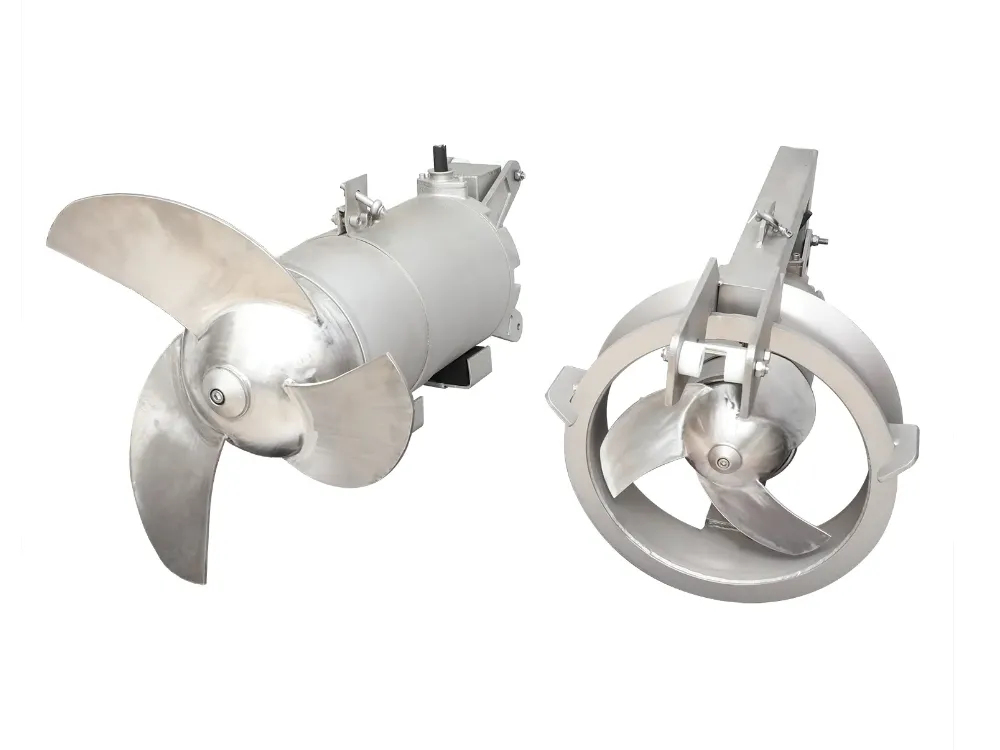
Define the mixing task before comparing motor labels
A useful submersible mixer price comparison starts with a shared duty description. Is the task to keep solids suspended, blend liquids, or circulate the tank contents? Provide the tank drawing, operating liquid levels, and available liquid data with that description.
Kairun’s submersible mixer selection guide explains how the task, tank layout, and liquid properties inform equipment review. Its guide to tank geometry and thrust covers the sizing inputs in more detail. Use those inputs to make the RFQ specific rather than choosing from a motor label alone.
Two offers with the same rated power still need a check of the proposed model and layout. Ask each supplier to identify the duty covered by its proposal and any assumptions that remain open. Do not use a price-per-kW calculation as proof that both arrangements suit the tank.
Compare materials, controls, and supporting documents
List the required materials and the liquid conditions they must suit. Ask for the proposed material specification rather than assuming that a broad term such as stainless steel settles the question. Keep the supplier’s stated operating limits attached to the proposed model.
For each submersible mixer price, check the control and protection scope. Name the required site power supply and control interface. If speed control is proposed, ask which equipment and related work are included; do not assume the mixer price covers the whole control package.
The same approach applies to documents. Specify the drawings, manuals, and performance information the project needs. A requested report and a supplied report are different states on the comparison sheet.
This third-party Sulzer video provides equipment background. It is not a Kairun product demonstration, price comparison, or proof that a particular mixer suits your tank.
Compare Equipment Price With Delivered and Installed Scope
Separate supplier delivery from site work
Keep the submersible mixer price for supply distinct from the work needed at the site. Ask who provides the mounting system, who checks its fit, and who covers the agreed installation tasks. Record the boundary between the equipment supplier and the site contractor.
For a retrofit, identify the existing rail, support, opening, and cable route. Do not mark an item reusable until the responsible team has confirmed it. The installation and guide rail planning guide helps organize those questions without treating a generic arrangement as an approved design.
Illustrative scenario: A project team plans to retain an old mounting bracket. Its fit with the proposed mixer has not been checked. The buyer keeps the bracket and any related site work open instead of recording an assumed saving against the new submersible mixer price.
Make commercial assumptions easy to find
Record the quote date, revision, currency, quantity, delivery location, and stated validity. Copy the offer’s delivery terms exactly, and ask the supplier to clarify any unclear responsibility. Do not replace missing freight or tax details with a standard percentage.
Use one comparison sheet for all offers:
| Comparison field | Offer A | Offer B |
|---|---|---|
| Quote reference and revision | Enter reference | Enter reference |
| Model, quantity, and duty basis | Attach proposal | Attach proposal |
| Base supply amount and currency | Enter quoted amount | Enter quoted amount |
| Required options | List separately | List separately |
| Freight, taxes, and site work | State terms or open | State terms or open |
| Warranty and service scope | Attach written terms | Attach written terms |
| Unresolved items and owner | Name next action | Name next action |
Compare the submersible mixer price only after noting which fields still differ. Keep the original offers with the worksheet so reviewers can check the source of each entry.
Log changes to the submersible mixer price comparison:
- What changed in the equipment or supply scope?
- Which quote revision contains the change?
- Does the change affect the other offers being compared?
- Who needs to answer the remaining question?
If a tank drawing changes, send that revision to all suppliers still under review. Don’t compare one updated proposal with another based on an old layout. Ask whether the change affects model selection, scope, or the quoted amount.
Consider Operating Cost Without Guessing Payback
Use electrical input and actual operating time
The purchase amount is one part of the decision. To review electricity cost, use measured or clearly stated average electrical input, operating hours, and the applicable energy tariff. Do not treat a motor’s rated shaft output as measured electrical consumption.
For a constant average input over a defined period:
Energy charge = average electrical input in kW × operating hours × energy rate per kWh.
This is a budget calculation, not a mixer sizing method. If input varies across operating states, calculate those states separately or use suitable measured energy data. Any fixed charges or demand charges need separate treatment where they apply.
A submersible mixer price comparison should label each operating-cost input as measured, supplied, assumed, or unknown. Use the same period and basis for the proposals being compared. Leave a result open when essential inputs are missing.
Request evidence before claiming a saving
Illustrative scenario: Two proposals have the same rated motor power. The owner does not yet have comparable electrical-input data or an agreed operating schedule. The buyer requests those inputs and leaves the payback field blank.
Maintenance, spare parts, and planned access also belong in the cost review. Request the model’s maintenance requirements and the relevant service scope, then use project data for any budget. Do not convert a public submersible mixer price into a lifecycle total with an unsupported multiplier.
Keep these inputs beside the submersible mixer price worksheet:
| Cost input | Evidence to attach | If missing |
|---|---|---|
| Average electrical input | Measurement or stated calculation basis | Leave open |
| Running hours | Agreed schedule and period | Request schedule |
| Energy rate | Applicable tariff and date | Request rate |
| Service and parts | Model requirements and priced scope | Request details |
Keep an operating-cost estimate separate from the quoted supply amount. That makes it possible to update an assumption without changing what the supplier actually offered.
Request a Comparable Quote: RFQ Checklist and FAQs
Send the same brief to each supplier
An RFQ should let each supplier see the same task and site limits. Use the current drawing revision, identify unknown values, and name the person who can resolve them. The goal is a submersible mixer price tied to a reviewable proposal.
Include:
- Mixing task, tank dimensions, layout, and working liquid levels.
- Available solids, liquid, temperature, and chemical data, with their sources.
- New-installation or retrofit scope, proposed quantity, and existing equipment details.
- Site power, control interface, and cable route requirements.
- Mounting, retrieval access, and installation responsibilities needing review.
- Required documents, spare parts, destination, and requested commercial scope.
Ask the supplier to return its model proposal, exclusions, options, and open questions with the quotation. Keep assumptions visible rather than asking for a total that hides them. A submersible mixer cost worksheet can then show both the amount and the basis for it.
Before purchase approval, give open technical questions to the project reviewer and open commercial questions to the buyer. Record their answers with the quote file. A submersible mixer price becomes easier to assess when everyone can see which questions are closed and which still need a decision.
How much does a submersible mixer cost?
The dated public examples above show specific seller listings, not a universal cost band. Your submersible mixer price needs a defined duty, selected model, and confirmed supply scope. Request a project quotation before treating a public amount as a purchase budget.
Are guide rails and controls included?
Check the written offer item by item. Ask whether rails, mounting hardware, controls, protection, and cables are included, optional, excluded, or not stated. Keep unresolved items on the RFQ record.
Can I compare mixers by price per kW?
That ratio alone does not establish suitability for the tank. First compare the task, proposed equipment, supporting data, and scope. Keep the rated-power label as one specification rather than treating it as the whole selection basis.
Does a listed price include delivery and installation?
It depends on the seller’s stated terms. Confirm the destination, freight, site work, and responsibilities in writing. Do not assume that an online listing covers the completed installation.
Prepare your project enquiry
Review Kairun’s submersible mixer options alongside your tank brief. Mark the required items, attach the available drawings, and list the questions that still need answers.
To request a submersible mixer price for your project, contact Kairun with your duty and scope sheet. Ask for the proposed model, included equipment, options, and commercial terms in the written response.